Uvod
Understanding how your digestive system works means following food through a remarkable process that begins in the mouth and continues through the stomach and intestines.
While a meal may take only minutes to eat, digestion, nutrient absorption, and waste elimination can take much longer.
And contrary to popular belief, digestion does not begin in the stomach. It starts in your mouth and depends on the coordinated work of several organs, digestive juices, muscles, nerves, and hormones.
Here is how your digestive system works, step by step, from the first bite to the final bowel movement.
How Your Digestive System Works: Four Essential Processes
The digestive system includes the digestive tract — a continuous passage from the mouth to the anus — and supporting organs such as the liver, pancreas, and gallbladder.
Its work involves four connected processes:
- Movement: Muscles carry food and fluids through the digestive tract.
- Digestion: Chewing, stomach acid, and enzymes break food into smaller components.
- Absorption: Nutrients and most water pass through the intestinal lining into blood or lymph.
- Elimination: Material the body does not absorb leaves as stool.
Carbohydrates are largely broken into simple sugars, proteins into amino acids, and fats into smaller molecules that can be absorbed. The body then uses these nutrients for energy, growth, maintenance, and repair.
1. Mouth: Digestion Starts With the First Bite
Your teeth begin mechanical digestion by cutting and grinding food into smaller pieces. Meanwhile, saliva moistens food, helping it move safely when you swallow.
Saliva contains amylase, an enzyme that starts breaking down starch. Your tongue mixes food with saliva into a soft mass called a bolus, then pushes it toward the throat.
Swallowing begins as a conscious action but quickly becomes an automatic sequence. Muscles guide food toward the esophagus while structures in the throat help protect your airway.
2. Esophagus: Moving Food Without Gravity
After swallowing, the bolus enters the esophagus, the muscular tube connecting the throat to the stomach.
A series of wave-like muscle contractions, called peristalsis, pushes it downward. Because these contractions provide the force, swallowed food can reach the stomach even when you are lying down.
At the bottom of the esophagus, a muscular valve called the lower esophageal sphincter relaxes to let food pass, then normally closes again.
Its job is important: it helps prevent acidic stomach contents from flowing back into the esophagus. When reflux happens frequently or causes complications, it may indicate gastroesophageal reflux disease (GERD).
3. Stomach: Acid, Enzymes, and Powerful Mixing
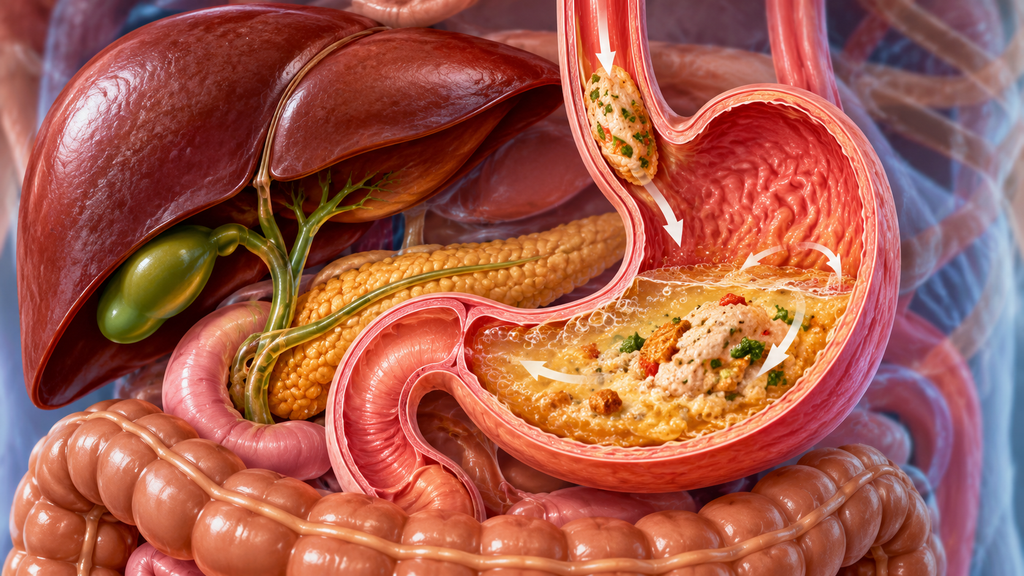
The stomach is both a temporary storage chamber and a muscular mixing organ. Its walls stretch to accommodate a meal, then contract to combine food with gastric juice.
How the Stomach Breaks Down Food
Inside the stomach, powerful muscular contractions mix food with gastric juice.
Hydrochloric acid helps unfold proteins and creates the acidic conditions needed for the enzyme pepsin to begin breaking them down.
As digestion continues, food gradually becomes a semi-liquid mixture called chyme, which is released into the small intestine in controlled amounts.
Why Doesn’t Stomach Acid Damage the Stomach?
The stomach protects itself with a mucus-rich barrier, bicarbonate near its lining, and cells that help maintain a tight protective surface. These defenses normally keep acid and digestive enzymes from injuring the stomach wall.
Does Food Stay in the Stomach for Hours?
Often, yes. The timing depends on meal size, composition, and individual factors. Liquids generally empty faster, while larger meals and foods high in fat can slow stomach emptying.
The stomach releases chyme gradually through the pylorus, a muscular opening leading into the small intestine. This controlled delivery allows the next organ to process food efficiently.
4. Small Intestine: The Main Site of Digestion and Absorption
The small intestine is where most chemical digestion is completed and most nutrients are absorbed. It consists of three sections: the duodenum, jejunum, and ileum.
In the first section, the duodenum, acidic chyme mixes with bile, pancreatic juice, and intestinal secretions. These fluids help neutralize the acid and continue breaking down carbohydrates, proteins, and fats.
The remaining sections complete much of the absorption process. The final section, the ileum, has an especially important role in absorbing vitamin B12 and recycling bile acids.
How the Liver, Gallbladder, and Pancreas Help
These organs support digestion without food passing through them.
The liver produces bile, which helps the body handle dietary fats. The gallbladder stores and concentrates bile between meals and releases it into the small intestine when needed.
Bile is not a digestive enzyme. Its bile acids help disperse fat into tiny droplets and support the absorption of fats and fat-soluble vitamins.
The pancreas releases enzymes that digest different nutrients: amylase for carbohydrates, proteases for proteins, and lipase for fats. It also provides bicarbonate to help neutralize stomach acid.
How Do Nutrients Enter the Body?
The small intestine has folds covered with tiny finger-like projections called villi. Even smaller projections, known as microvilli, cover the cells on their surface.
This structure greatly expands the area available for absorption.
- Simple sugars and amino acids enter the blood and travel first to the liver.
- Most absorbed long-chain dietary fats are repackaged inside intestinal cells and initially transported through lymphatic vessels.
- Vitamins, minerals, and water enter through different absorption pathways.
In other words, eating provides nutrients, but absorption is what makes those nutrients available to the body.
5. Large Intestine: Recovering Water and Preparing Waste
What remains after the small intestine passes into the large intestine, or colon. This material includes undigested components such as some dietary fiber, along with water, bacteria, and substances released into the digestive tract.
How the Colon Absorbs Water
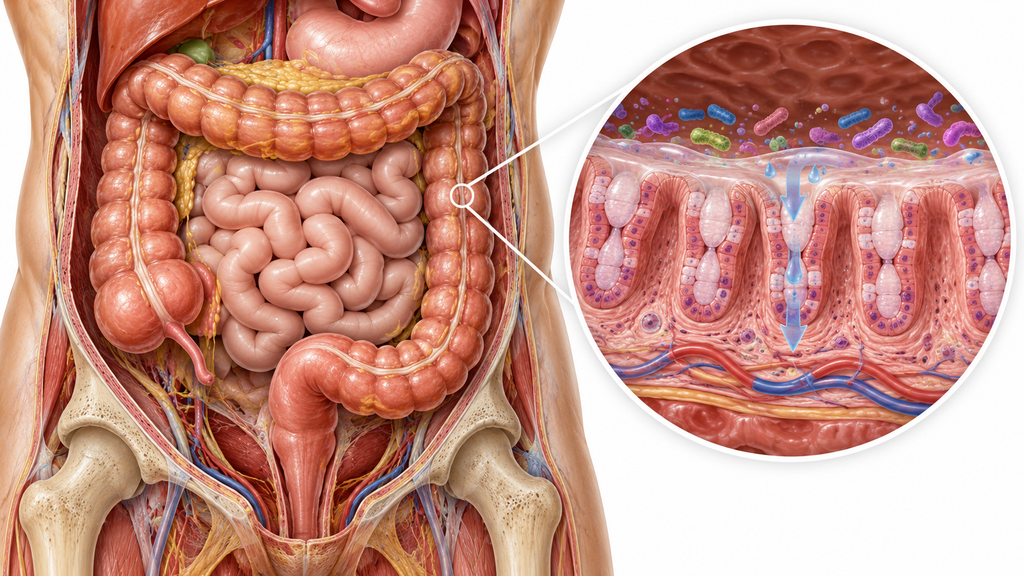
The colon absorbs remaining water and electrolytes, gradually transforming intestinal contents into more solid stool. Unlike the small intestine, the colon has no villi. Its lining contains intestinal crypts and mucus-producing goblet cells that help protect the intestinal surface. The colon also provides an environment where gut bacteria break down certain undigested fibers.
What Does the Gut Microbiome Do?
The colon contains a large community of microorganisms known as the gut microbiome. Some of these microbes ferment fibers that human digestive enzymes cannot break down.
Fermentation produces short-chain fatty acids, which can help nourish cells lining the colon. Gut microbes also contribute to certain vitamin-related processes and interact with the immune system.
However, the microbiome differs from person to person, and no single bacterial profile guarantees good digestive health.
As stool moves onward, it enters the rectum, where it is stored until a bowel movement. Nerve signals and coordinated muscle actions then allow stool to pass through the anus.
How the Digestive System Controls Digestion
Digestion runs largely without conscious effort because the gut has its own network of nerves, known as the enteric nervous system.
These nerves help coordinate muscle contractions, digestive secretions, and movement through the intestines. They also communicate with the brain, which helps explain why stress can sometimes affect bowel habits or abdominal sensations.
Hormones provide additional instructions, including signals that influence stomach emptying, pancreatic secretions, and bile release.
How Long Does Food Take to Digest?
There is no exact timetable for every meal. Digestion and transit depend on the food eaten, meal size, medications, individual physiology, and bowel habits.
Food usually passes through the esophagus within seconds. Processing in the stomach and movement through the small intestine take several hours. Material may then spend another day or two in the colon, sometimes longer.
From eating to elimination, the entire journey commonly takes around one to several days.
If you feel the urge to have a bowel movement soon after eating, it does not mean that the new meal has already passed through your body. Eating can activate the gastrocolic reflex, which stimulates movement of material already in the colon.
What Can Disrupt Normal Digestion?
Digestive symptoms may develop when food movement, enzymes, absorption, or intestinal function is disturbed.
For example, acid reflux involves stomach contents moving backward into the esophagus. Lactose intolerance results from insufficient lactase to digest lactose effectively. In celiac disease, gluten triggers an immune response that damages the small-intestinal lining in affected people.
Constipation and diarrhea can also reflect changes in intestinal movement, fluid handling, or other underlying conditions.
Seek medical assessment for persistent digestive changes, unexplained weight loss, or difficulty swallowing. Severe abdominal pain, vomiting blood, or black, tarry stools require urgent medical attention.
Simple Habits That Support Healthy Digestion
Most people do not need elaborate routines or special products to support normal digestive function.
- Choose fiber-rich foods. Vegetables, fruit, legumes, and suitable whole grains support bowel regularity and provide material for microbial fermentation.
- Drink enough fluids. Adequate hydration helps maintain normal stool consistency, particularly when increasing dietary fiber.
- Move regularly. Walking and other physical activity can support bowel function.
- Eat at a comfortable pace. Chewing thoroughly makes food easier to swallow and can help you recognize fullness.
- Notice persistent changes. Ongoing pain, diarrhea, constipation, or bloating deserves attention rather than repeated guesswork.
Digestive health is not about achieving a perfect bowel schedule. It is about supporting normal function and recognizing changes that may need evaluation.
Često postavljana pitanja
Does digestion begin in the stomach?
No. Chewing and salivary amylase begin digestion in the mouth. The stomach continues the process, especially for proteins.
Is most food absorbed in the stomach?
No. The small intestine absorbs the vast majority of nutrients. The stomach mainly stores, mixes, and partly digests food.
Can drinking water with meals dilute stomach acid too much?
For most healthy people, normal amounts of water with meals do not impair digestion. The stomach regulates its secretions as needed.
Why does my stomach growl even when I am not hungry?
Digestive sounds often come from gas and fluid moving through the stomach or intestines. They can occur with or without hunger.
Can stress change how quickly food moves through the intestines?
Yes. Signals between the brain and digestive tract can affect movement and sensitivity, sometimes contributing to diarrhea, constipation, or discomfort.
Zaključak
Understanding how your digestive system works reveals how several organs coordinate to break down food, absorb essential nutrients, and eliminate waste.
Understanding this journey makes it easier to appreciate the roles of each organ — and to recognize why persistent digestive symptoms deserve attention.
Izvori i naučna literatura
- National Institute of Diabetes and Digestive and Kidney Diseases (NIDDK). Your Digestive System & How It Works.
- Merck Manual Consumer Version. Overview of the Digestive System.
- Basile EJ, Shukla K, Launico MV, Sheer AJ. Physiology, Nutrient Absorption. StatPearls. NCBI Bookshelf. Updated December 2025.
- Cleveland Clinic. Large Intestine & Colon: Function, Anatomy & Location.
- University of Leeds — The Histology Guide. Large Intestine.