When the heart can no longer pump blood effectively, circulation to the brain and other vital organs suddenly stops. Without immediate help, serious injury can develop within minutes. Understanding how chest compressions work helps explain why CPR can maintain vital blood flow until emergency treatment becomes available.
Cardiopulmonary resuscitation (CPR) buys time. Chest compressions create pressure that moves a limited amount of blood through the body, helping preserve vital organ function until emergency care can restore effective circulation.
But how can pushing on someone’s chest move blood when the heart is not beating normally?
Understanding how chest compressions work reveals why both the downward pressure and the release between compressions are essential for maintaining circulation.
In an emergency: If someone is unresponsive, call your local emergency number immediately. If they are not breathing normally, begin CPR and use an automated external defibrillator (AED) as soon as one is available.
What Happens During Cardiac Arrest?
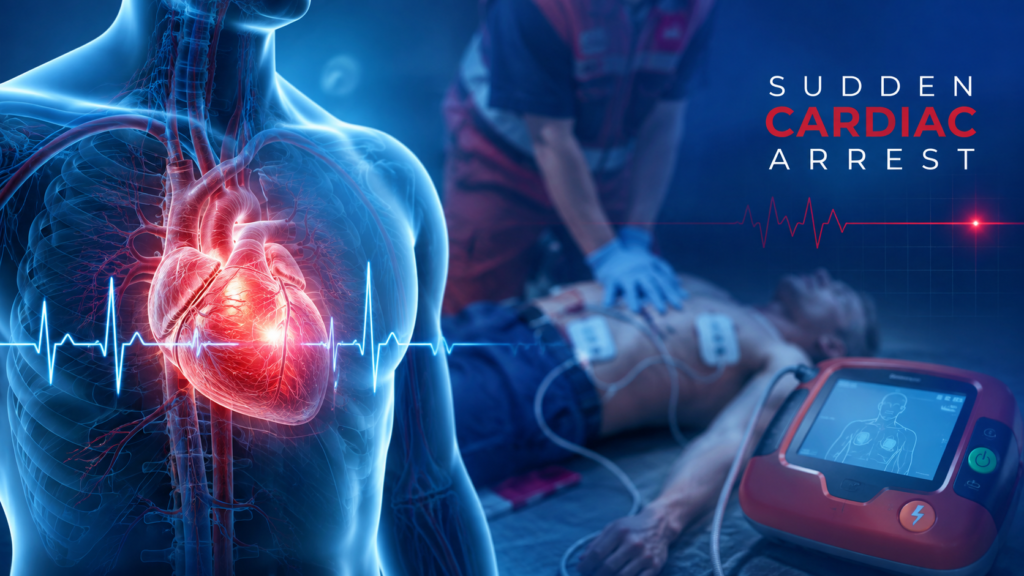
Cardiac arrest occurs when the heart suddenly stops pumping blood effectively. It may result from a dangerous abnormal heart rhythm or another critical problem that prevents adequate circulation.
Within seconds, reduced blood flow to the brain usually causes loss of consciousness. Breathing may stop or become abnormal, and brain injury can begin within minutes if circulation is not restored.
Warning signs of cardiac arrest include:
- Sudden collapse or loss of responsiveness.
- Absent breathing or breathing that is not normal.
- Occasional gasps, snoring-like breaths, or other irregular breathing movements.
These gasps, called agonal breathing, do not provide effective ventilation. They must not be mistaken for normal breathing. Learn more about the causes and warning signs in our guide to sudden cardiac arrest.
Cardiac Arrest vs. Heart Attack
A heart attack occurs when blood flow to part of the heart muscle is blocked.
During cardiac arrest, the heart fails to pump blood effectively throughout the body.
A heart attack can cause cardiac arrest, but the conditions are not the same.
How Chest Compressions Work to Maintain Blood Flow
A healthy heart generates pressure with each beat, moving blood through arteries and delivering oxygen to tissues.
During cardiac arrest, that pumping action is lost or severely impaired.
CPR creates a temporary, less effective substitute for the heart’s pumping action.
Each downward press and release changes pressure inside the chest, helping blood move forward and return to the heart.

The Compression Phase: Pushing Blood Forward
When a rescuer presses on the center of the chest, the breastbone moves downward.
This increases pressure within the chest and may also compress the heart directly between the breastbone and spine.
Together, these effects help propel some blood into the circulation.
Researchers describe them as the chest-pump and cardiac-pump mechanisms.
Their relative contribution varies, but both help explain how external chest compressions can generate blood flow.
The resulting circulation is much weaker than a normal heartbeat.
Nevertheless, even limited flow can deliver oxygen to organs that are highly sensitive to oxygen deprivation.
The Release Phase: Letting the Heart Refill
Blood cannot keep moving forward unless it can also return to the heart.
When downward pressure is released, the chest expands toward its normal shape.
Pressure inside the chest falls, supporting blood return to the heart before the next compression.
This is called chest recoil.
If a rescuer leans on the chest between compressions, pressure remains elevated and blood return may be reduced.
Every compression has two essential parts: press down firmly, then allow the chest to recoil completely.
Repeating this cycle generates the limited circulation that CPR can provide.
Why Continuous Compressions Matter
Each pause stops this artificial pumping action.
Pressure supporting blood flow to the heart quickly falls, and subsequent compressions are needed to rebuild it.
For this reason, effective CPR involves not only proper depth and speed but also as few interruptions as possible.
Why the Brain and Heart Need CPR Immediately
The brain depends on a continuous supply of oxygen-rich blood. Understanding how chest compressions work helps explain why immediate CPR is so important for protecting vital organs during cardiac arrest.
When circulation stops, consciousness can be lost within seconds and the risk of permanent injury rises as oxygen deprivation continues.
Chest compressions cannot guarantee protection against brain damage. They can, however, maintain some blood flow while emergency treatment is arranged.
The heart muscle also needs its own blood supply, delivered by the coronary arteries.
CPR helps support coronary circulation, which can improve the conditions for restoring an effective heartbeat.
This is the central purpose of CPR: preserve a measure of circulation until the underlying cause of cardiac arrest can be treated.
How to Recognize Cardiac Arrest
You do not need medical equipment to identify a suspected cardiac arrest.
Step 1: Check for responsiveness.
Make sure it is safe to approach, speak loudly, and gently tap the person’s shoulders.
Step 2: Call emergency services immediately if there is no response.
Use speakerphone so the dispatcher can help while you assess breathing.
Step 3: Check whether breathing is normal.
Gasping, slow irregular breaths, and unusual snoring-like sounds are not normal breathing.
Step 4: Start CPR if the person is unresponsive and not breathing normally.
Ask someone else to get an AED, if available. Do not delay CPR to search for a pulse.
Pulse checks are not recommended for members of the public because they are difficult to perform reliably and can waste precious time.
If you are uncertain whether breathing is normal, follow the emergency dispatcher’s instructions.
How to Perform High-Quality Adult Chest Compressions
These steps apply to adult CPR. CPR techniques for infants and children differ.
Position Yourself and Your Hands
Have the person on their back if possible.
A firm surface is preferable, but do not delay starting CPR to move someone from a bed or another soft surface.
Kneel beside the chest.
Place the heel of one hand in the center of the chest, on the lower half of the breastbone, and your other hand on top.
Keep your arms straight and shoulders directly above your hands.

Compress at the Correct Depth and Rate
Push down firmly so the chest moves at least 5 cm (about 2 inches), but not more than 6 cm (about 2.4 inches) for an average adult.
Aim for 100–120 compressions per minute.
Use your upper-body weight rather than relying only on arm strength.
Allow Full Recoil and Limit Pauses
After every compression, release all downward pressure so the chest rises fully.
Keep your hands in position, but do not lean on the chest.
Continue steadily, minimizing interruptions.
If another rescuer is available, switch who performs compressions about every two minutes, keeping the changeover brief.
Remember the essentials: correct hand position, 5–6 cm depth, 100–120 compressions per minute, full recoil, and minimal pauses.
Hands-Only CPR or CPR With Breaths?
Both approaches can save lives, but the best choice depends on the situation and the rescuer’s training.
Hands-Only CPR
For an untrained person helping an adult in suspected cardiac arrest, continuous chest compressions are recommended.
Hands-only CPR avoids delays associated with attempting unfamiliar breathing techniques.
Some oxygen remains in the blood immediately after sudden cardiac arrest, and compressions help circulate it.
But oxygen levels fall over time, which is why breathing support also matters.
CPR With Breaths
If you are trained and able to give breaths, use 30 chest compressions followed by 2 breaths.
Open the airway and give each breath over about one second—just enough to make the chest visibly rise.
Resume compressions promptly.
Breaths are especially important when cardiac arrest follows a breathing problem, such as drowning, and in most pediatric cardiac arrests.
Pediatric resuscitation requires age-appropriate techniques.
If you cannot give breaths, do not stop: continue chest compressions.
How CPR and an AED Work Together
CPR maintains limited circulation, but it does not usually correct the dangerous heart rhythm causing cardiac arrest.
An automated external defibrillator AED analyzes the heart’s rhythm and determines whether an electrical shock is needed. Depending on the device, it either instructs the rescuer to press a button or delivers the shock automatically.
A shock may stop a life-threatening rhythm and allow the heart to resume an effective pumping pattern.
Some cardiac arrests have rhythms that cannot be treated with a shock. In those cases, the AED will not advise one.

Can Anyone Use an AED?
Yes.
Anyone can use an AED, even without formal medical training.
Turn it on, expose the chest, attach the pads as illustrated, and follow the spoken instructions.
Make sure nobody is touching the person when the device analyzes the rhythm or delivers a shock.
Resume CPR immediately when the AED instructs you to, whether or not a shock was given.
CPR and defibrillation are complementary: one supports circulation; the other can treat certain abnormal heart rhythms.
Neither replaces urgent professional medical care.
Can Chest Compressions Cause Injuries?
Chest compressions can cause rib or breastbone fractures.
These injuries are possible even when CPR is performed correctly, but the danger of untreated cardiac arrest is far greater.
If you hear or feel a crack, check your hand position and continue compressions.
Do not let fear of injury prevent you from helping someone who may be in cardiac arrest.
When Should You Stop CPR?
Continue CPR until:
- Emergency professionals take over.
- The person shows clear signs of life and begins breathing normally.
- You are physically unable to continue.
- The scene becomes unsafe.
Follow the emergency dispatcher’s instructions throughout.
Occasional gasping alone is not a reason to stop.
If the person begins breathing normally, follow the emergency dispatcher’s instructions and continue monitoring their breathing until professional help arrives.
Frequently Asked Questions
Can CPR restart the heart?
CPR does not usually restart the heart on its own. It generates limited blood flow while defibrillation and other emergency treatments may help restore effective circulation.
Does CPR provide normal blood circulation?
No. Even high-quality CPR produces substantially less blood flow than a normally functioning heart. Its value is in sustaining some circulation during a life-threatening emergency.
Is hands-only CPR enough?
For untrained rescuers responding to a sudden collapse in an adult, hands-only CPR is recommended. Trained rescuers who can provide effective breaths should generally combine them with compressions.
Should I start CPR if I am not certain the person is in cardiac arrest?
If an adult is unresponsive and not breathing normally, call emergency services and start CPR. Do not delay while checking for a pulse. The dispatcher can guide you.
Conclusion
Understanding how chest compressions work reveals how repeated pressure changes inside the chest help maintain limited blood circulation during cardiac arrest.
This temporary circulation helps supply the brain and heart with oxygen when the heart cannot pump effectively.
CPR is not a cure for cardiac arrest, but it can provide critical time for defibrillation and advanced medical treatment.
Recognize the emergency, call for help, start compressions, and use an AED as soon as possible.
Sources & Medical References
- 1. American Heart Association (2025)-Adult Basic Life Support
- 2.European Resuscitation Council (2025)-ERC Guidelines 2025: Adult Basic Life Support
- 3. American Heart Association What Is CPR?
- 4. Resuscitation Council UK (2025) Adult Basic Life Support Guidelines
Medical Disclaimer
This article is intended for educational and informational purposes only. It does not replace professional CPR training, emergency medical assistance, or instructions from emergency dispatchers. In a suspected cardiac arrest, contact your local emergency services immediately.