
For millions of people, the morning begins the same way: wake up, reach for the coffee machine, and drink the first cup before having a single glass of water.
Coffee is often described as a diuretic, while the body naturally loses water overnight through breathing, sweating, and urine production. At the same time, heart attacks and strokes are known to occur more frequently during the morning hours.
Put those facts together, and an alarming theory seems obvious: Does drinking coffee before water leave the blood more concentrated and increase the risk of a heart attack or stroke?
The reality is more complicated — and far more interesting.
Coffee does contain caffeine, which can increase urine production under certain circumstances. But moderate coffee consumption does not normally cause significant dehydration in people who regularly drink it. More importantly, the morning increase in cardiovascular events appears to be driven primarily by the body’s circadian rhythm, blood-pressure surge, sympathetic nervous system activation, platelet activity, and changes in the body’s ability to dissolve blood clots.
So what really happens inside your body during those first hours after waking?
Your Body Has Already Gone Hours Without Drinking
During sleep, most people spend several hours without consuming any fluids.
That does not mean the body becomes dangerously dehydrated overnight. However, water continues to leave the body through breathing, urine, and perspiration.
When you wake up, your hydration status therefore may be slightly different from when you went to bed, particularly after a hot night, heavy sweating, illness, alcohol consumption, or inadequate fluid intake during the previous day.
This has led to the popular recommendation to drink water immediately after waking.
For most healthy people, drinking water in the morning is a perfectly reasonable habit. But the idea that everyone wakes with dangerously “thick blood” that must be diluted with water before drinking coffee is an oversimplification of human physiology.
Is Coffee Really a Diuretic?
Yes — but this statement needs context.
Caffeine can have a diuretic effect, meaning it can temporarily increase urine production. The magnitude of that effect depends partly on the amount of caffeine consumed and how accustomed a person is to caffeine.
Research comparing different caffeine doses has found that high doses can significantly increase short-term urine production, while lower doses may have little meaningful effect on fluid balance.
Regular coffee drinkers also develop some tolerance to caffeine’s effects.
Most importantly, coffee itself contains a large amount of water.
This means that drinking a normal cup of coffee does not simply remove water from your body. You are consuming fluid at the same time as caffeine.
In a controlled study of habitual coffee drinkers, moderate coffee intake produced hydration measurements similar to those seen when participants consumed water.
So although caffeine has diuretic properties, saying that “coffee dehydrates you” is generally too simplistic.
Does Coffee Make Your Blood Thicker?
This is another common claim that requires clarification.
Severe dehydration can reduce plasma volume and influence blood viscosity and cardiovascular function. But there is no good evidence that drinking an ordinary cup of coffee before water suddenly makes the blood dangerously thick or triggers clot formation in a healthy person.
And this distinction is important.
Heart attacks and ischemic strokes usually involve complex disease processes that develop over years.
In a heart attack, an atherosclerotic plaque inside a coronary artery may become disrupted, triggering platelet activation and formation of a blood clot that restricts blood flow to heart muscle.
In an ischemic stroke, blood flow to part of the brain becomes blocked, often because of a thrombus or embolus.
Hydration can influence circulation, but these events cannot generally be explained simply by whether someone drank a glass of water before their morning coffee.
But Heart Attacks Really Do Occur More Often in the Morning
This part is not a myth.
Cardiovascular events demonstrate a circadian pattern, with myocardial infarction and stroke showing a recognized increase during the morning hours.
The explanation appears to involve several physiological systems becoming active at approximately the same time.
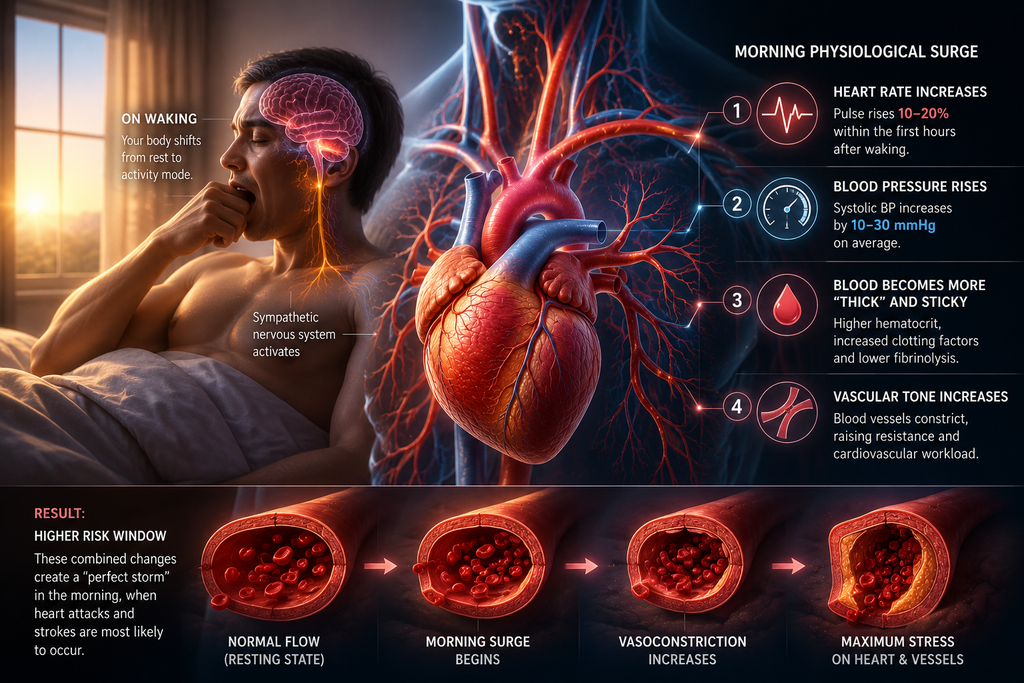
When you wake up, your cardiovascular system transitions from the relatively inactive state of sleep into daytime activity.
The sympathetic nervous system becomes more active. Levels of stress-related hormones change. Heart rate and vascular tone increase, and blood pressure begins to rise.
For most people, these changes are normal.
But for someone with vulnerable atherosclerotic plaques or significant cardiovascular disease, the morning transition may create a more challenging cardiovascular environment.
The Morning Blood-Pressure Surge
Blood pressure normally falls during sleep and begins rising around the time we wake.
This phenomenon is often called the morning blood-pressure surge.
The sympathetic nervous system becomes more active, blood vessels constrict more strongly, and the heart begins responding to the physical demands of standing, walking, working, exercising, and starting the day.
Imagine an artery containing an unstable atherosclerotic plaque.
The plaque may have been developing silently for many years. Increasing mechanical stress on the arterial wall is only one part of a much larger biological process, but changes in pressure, vascular tone, inflammation, and thrombosis can potentially contribute to the conditions surrounding an acute cardiovascular event.
The morning therefore represents a period of significant cardiovascular transition.
Your Blood-Clotting System Also Has a Biological Clock
Perhaps the most fascinating part of the story happens inside the blood itself.
The systems responsible for forming and dissolving blood clots are not equally active throughout the entire day.
Research into circadian hemostasis suggests that platelet activity, coagulation pathways, and fibrinolysis all demonstrate time-of-day variation.
Platelets are tiny blood components that help stop bleeding by forming plugs at sites of vascular injury. They are essential for survival, but excessive platelet activation also plays an important role in arterial thrombosis.
At the same time, the body has a protective system called fibrinolysis, which helps break down blood clots.
In simple terms, the early morning can temporarily create conditions that are somewhat more favorable to clot formation and less favorable to clot breakdown.
That helps explain why cardiovascular events do not occur completely randomly throughout the day.
So Where Does Morning Coffee Fit Into This?
Coffee enters an already active physiological environment.
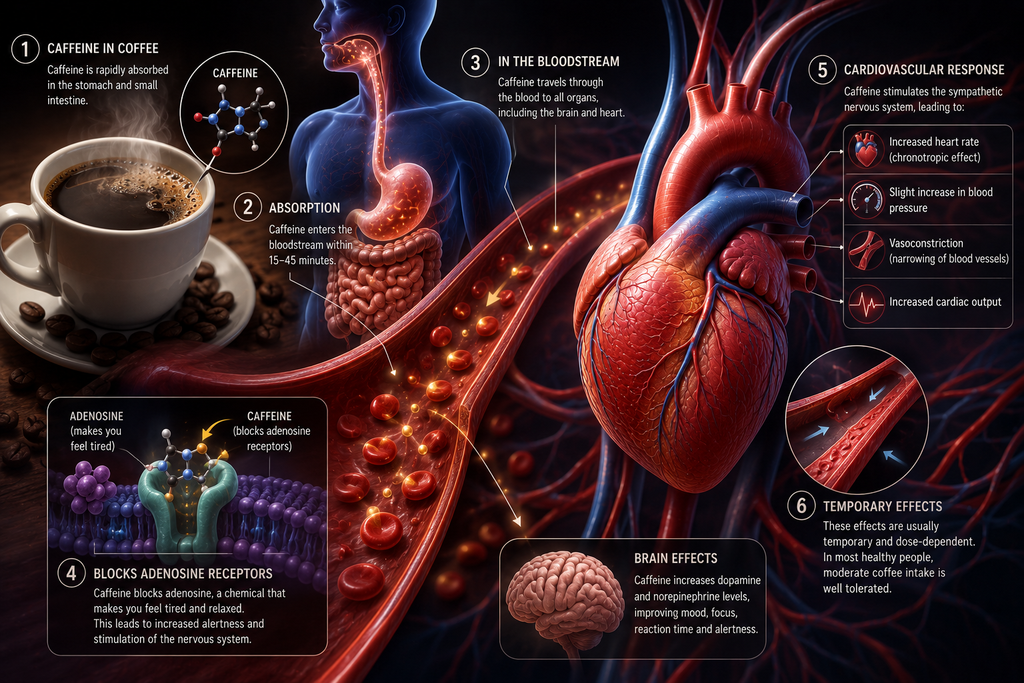
Caffeine stimulates the central nervous system and can temporarily affect cardiovascular parameters such as blood pressure, particularly in people who are not accustomed to consuming it. This does not mean that morning coffee causes heart attacks.
The important distinction is between an acute physiological effect and long-term cardiovascular risk. A temporary change in blood pressure after caffeine consumption does not automatically translate into an increased probability of suffering a heart attack.
Coffee Before Water: Dangerous Habit or Internet Myth?
For a generally healthy adult accustomed to caffeine, having a normal cup of coffee before drinking water is not known to be a major cardiovascular danger.
There is currently no convincing evidence that this specific sequence —
wake up → coffee → water, rather than — wake up → water → coffee
determines whether someone will experience a heart attack or stroke.
The morning cardiovascular peak is real.
The idea that coffee before water is the main reason for it is not.
This distinction matters because focusing on a glass of water can distract from cardiovascular risk factors that have much stronger scientific evidence behind them.
What Actually Matters for Cardiovascular Risk?
Long-term cardiovascular health depends much more on established factors such as hypertension, smoking, abnormal cholesterol levels, diabetes, obesity, physical inactivity, age, genetics, sleep disorders, and existing atherosclerotic disease.
For people who already have cardiovascular disease or poorly controlled hypertension, individual responses to caffeine may also deserve more attention.
Water remains essential for normal cardiovascular and kidney function, and maintaining adequate hydration throughout the day is important.
But there is no need to treat morning coffee as though it suddenly turns normal blood into dangerous, clot-prone blood.
Should You Drink Water Before Your Morning Coffee?
You certainly can.
After several hours without drinking, a glass of water is a simple way to begin replacing overnight fluid losses.
But it should be viewed as a healthy hydration habit — not as an emergency cardiovascular intervention.
For most people, the bigger picture matters much more: staying adequately hydrated throughout the day, controlling blood pressure, exercising regularly, avoiding smoking, maintaining healthy metabolic markers, sleeping adequately, and addressing cardiovascular risk factors when they are present.
And if you enjoy your morning coffee?
Current evidence does not suggest that you need to fear your cup simply because you have not had water first.
The Bottom Line
Heart attacks and strokes really do show a fascinating relationship with the body’s internal clock.
During the morning hours, several changes occur simultaneously: sympathetic nervous system activity increases, blood pressure rises, vascular tone changes, platelets become more reactive, and the balance between clot formation and clot breakdown shifts.
For someone with underlying cardiovascular disease, these processes may help create a period of increased vulnerability.
Coffee, meanwhile, is more complicated than its reputation as a “dehydrating drink.” Caffeine can increase urine production, particularly at higher doses, but moderate coffee intake in habitual coffee drinkers does not necessarily cause dehydration.
So the science gives us a much more interesting conclusion than the popular myth:
The morning cardiovascular risk is real. The idea that drinking coffee before water is what causes it is not supported by current evidence.
A glass of water after waking is a sensible habit.
But protecting your heart and brain requires much more than deciding which drink comes first.
FAQ
Does coffee dehydrate you?
Moderate coffee consumption generally does not cause significant dehydration in habitual coffee drinkers. High caffeine doses can have a stronger diuretic effect.
Is it bad to drink coffee before water in the morning?
For most healthy people, there is no strong evidence that drinking coffee before water significantly increases cardiovascular risk.
Why are heart attacks more common in the morning?
The morning is associated with increased sympathetic activity, rising blood pressure and vascular tone, greater platelet reactivity, and circadian changes in fibrinolysis and coagulation.
Can morning coffee cause a heart attack?
A normal cup of coffee cannot generally be described as a direct cause of heart attack. Individual responses to caffeine differ, particularly regarding acute blood-pressure effects.
Should I drink water before coffee?
Drinking water after waking is a reasonable way to replace overnight fluid losses, but there is no good evidence that water must be consumed before coffee specifically to prevent heart attack or stroke.
Sources
- Killer SC, Blannin AK, Jeukendrup AE. No Evidence of Dehydration with Moderate Daily Coffee Intake: A Counterbalanced Cross-Over Study in a Free-Living Population.
- Seal AD, Bardis CN, Gavrieli A, et al. Coffee with High but Not Low Caffeine Content Augments Fluid and Electrolyte Excretion at Rest.
- Circadian Clock Regulation of Hemostasis: A Systematic Review of Molecular Pathways. Research and Practice in Thrombosis and Haemostasis.
- Impact of the Circadian Clock on Fibrinolysis and Coagulation in Healthy Individuals and Cardiovascular Patients. Thrombosis Research.
- Ungvari Z, Kunutsor SK. Coffee Consumption and Cardiometabolic Health: A Comprehensive Review of the Evidence.