
Every second of your life, trillions of red blood cells are traveling through an extraordinary network of blood vessels.
They move through your heart, rush toward your lungs, collect oxygen, travel through arteries, squeeze through microscopic capillaries and eventually return to the heart to begin the journey again.
You never feel this enormous transportation system working — yet nearly every cell in your body depends on it.
So what actually happens to a red blood cell as it travels through your body?
Let’s follow one.
Meet the Red Blood Cell
Red blood cells, also called erythrocytes, are specialized blood cells whose primary role is transporting oxygen from the lungs to tissues throughout the body.
Their distinctive biconcave shape — thinner in the center and thicker around the edges — provides a large surface area for gas exchange and helps them remain flexible enough to pass through extremely narrow capillaries.
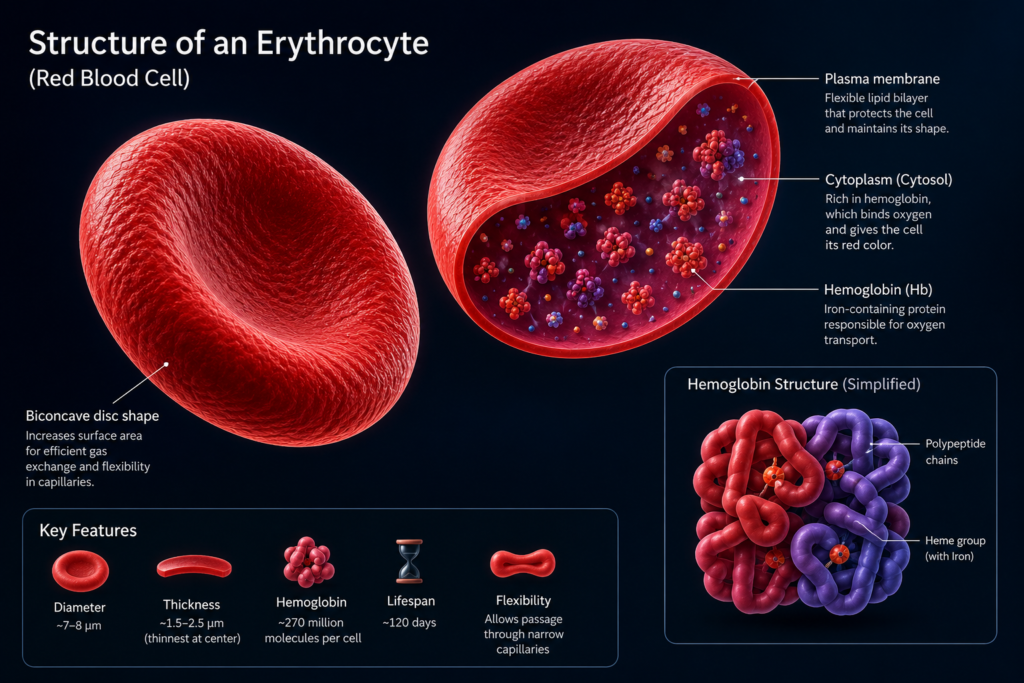
Inside each red blood cell are millions of molecules of hemoglobin, an iron-containing protein capable of binding oxygen.
This makes a red blood cell something like a microscopic oxygen transport vehicle.
But our journey begins after much of that oxygen has already been delivered.
Step 1: Returning From the Body
Imagine our red blood cell has just traveled through the tissues of your leg.
It has delivered much of its oxygen to cells that need it for metabolism. At the same time, carbon dioxide produced by those cells enters the blood and is transported toward the lungs for removal.
The blood is now relatively oxygen-poor.
Small veins gradually merge into increasingly larger veins as blood moves toward the heart.
Eventually, blood from the lower part of the body reaches a huge vein called the – vena cava inferior.
Blood returning from the head, neck, arms and upper chest arrives through another large vessel — the vena cava superior.
Both empty into the same destination:
Our red blood cell has reached the heart – The right atrium.
Step 2: Entering the Right Side of the Heart
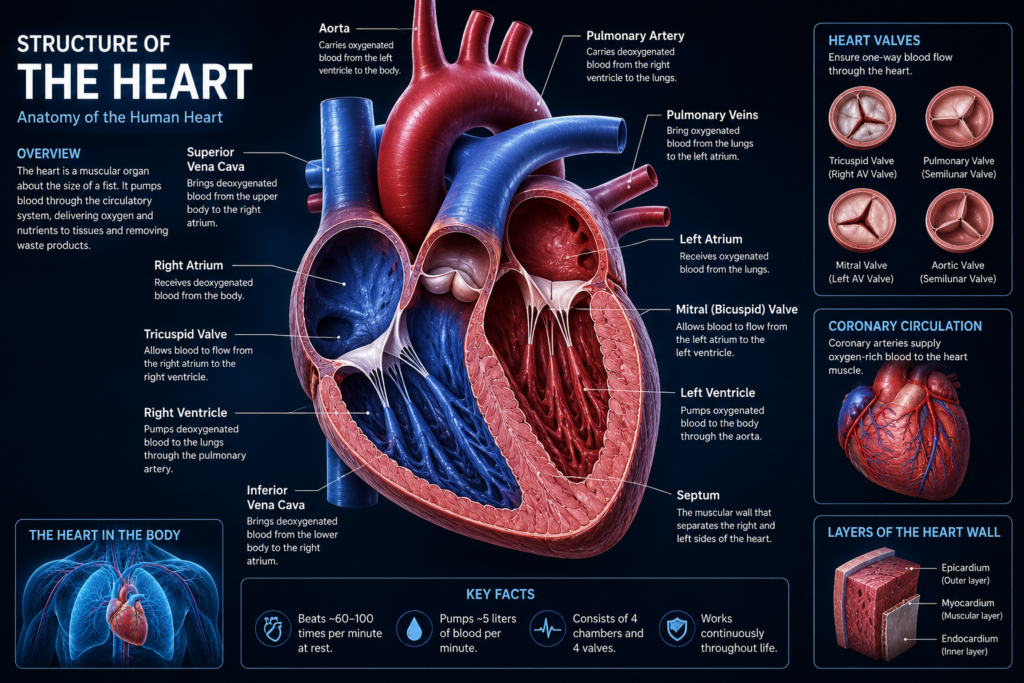
The heart contains four chambers:
- Right atrium
- Right ventricle
- Left atrium
- Left ventricle
The right side primarily receives oxygen-poor blood returning from the body and sends it toward the lungs.
Our red blood cell first enters the right atrium.
From there, it passes through the tricuspid valve and enters the right ventricle.
Heart valves act as one-way gates. Their coordinated opening and closing helps keep blood moving in the correct direction.
When the right ventricle contracts, pressure rises.
The tricuspid valve closes behind the blood, while the pulmonary valve opens ahead.
Our red blood cell is pushed out of the heart.
Its next destination is the lungs.
Step 3: Traveling Through the Pulmonary Arteries
After leaving the right ventricle, blood enters the pulmonary trunk, which divides into the right and left pulmonary arteries.
Here we encounter an important exception to a common rule.
Arteries are often described as vessels carrying oxygen-rich blood, but that definition isn’t completely accurate.
An artery is actually defined by the direction of blood flow: arteries carry blood away from the heart. The pulmonary arteries therefore carry oxygen-poor blood away from the heart and toward the lungs.
As our red blood cell travels deeper into the lungs, the pulmonary arteries divide repeatedly into smaller vessels.
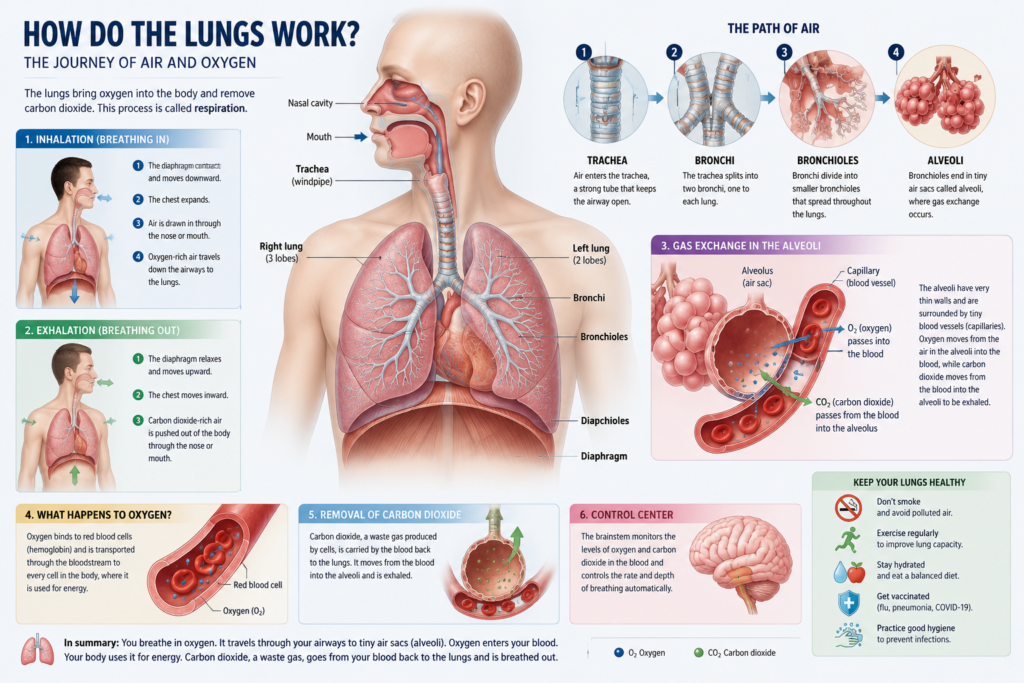
Eventually, it reaches a network of tiny pulmonary capillaries surrounding the lungs’ microscopic air sacs — the alveoli.
Step 4: Picking Up Oxygen in the Lungs
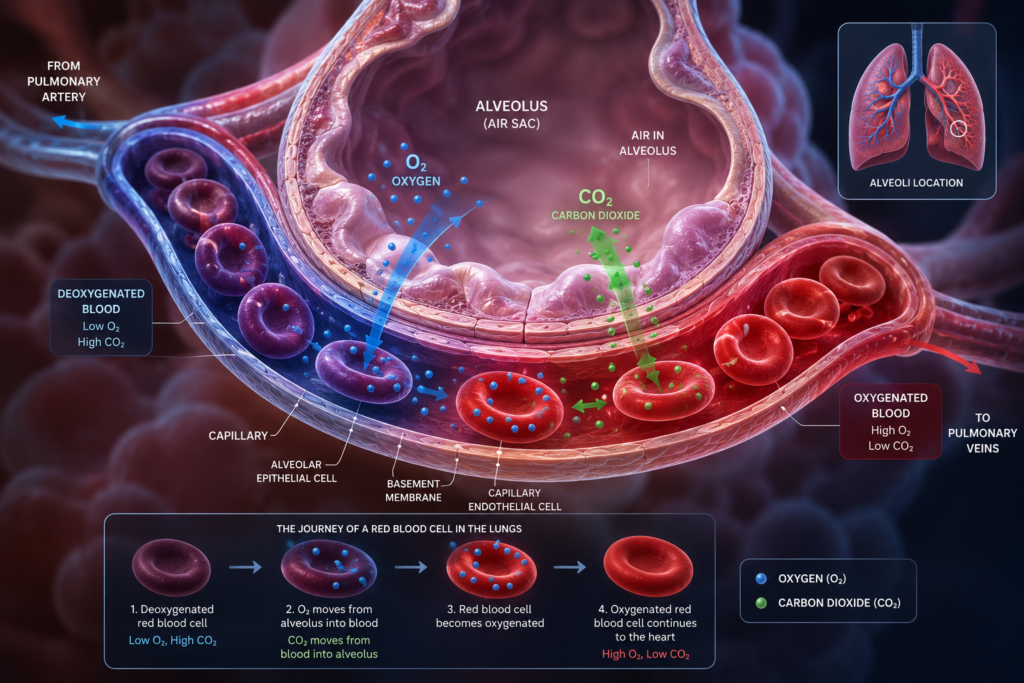
The walls separating air inside the alveoli from blood inside pulmonary capillaries are extremely thin.
This allows gases to move between the lungs and bloodstream.
Oxygen from inhaled air crosses into the blood and binds to hemoglobin inside red blood cells.
At the same time, carbon dioxide moves in the opposite direction — from the blood toward the alveoli — so it can eventually leave the body when you exhale.
Our red blood cell is now carrying a fresh supply of oxygen.
It is ready to return to the heart.
Step 5: Returning to the Left Side of the Heart
Oxygen-rich blood leaves the lungs through the pulmonary veins.
These vessels provide another useful exception to remember.
Most veins carry oxygen-poor blood, but pulmonary veins carry oxygen-rich blood.
Again, what defines a vein is not oxygen content.
Veins are vessels that carry blood toward the heart.
The pulmonary veins deliver our red blood cell into the left atrium.
From there, it passes through the mitral valve and enters the left ventricle.
And now it has arrived at the most powerful pumping chamber of the heart.
Step 6: The Left Ventricle — Preparing for the Big Journey
The left ventricle has a particularly thick muscular wall because it must generate enough pressure to send blood through the systemic circulation.
When it contracts, the mitral valve closes and the aortic valve opens.
Our oxygen-loaded red blood cell is propelled through the valve and into the largest artery in the body:
The aorta.
From here, blood can reach almost every region of the body.
The journey through the systemic circulation has begun.
Step 7: From the Aorta to the Arteries
Think of the circulatory system like an enormous branching transportation network.
The aorta is the main highway.
Large arteries branch from it and divide into progressively smaller arteries. Those vessels eventually become smaller arterioles, which lead toward networks of capillaries.
Different branches deliver blood to different organs and tissues.
Some travel toward the brain.
Others supply the kidneys, digestive organs, muscles and skin.
Even the heart needs its own blood supply. The coronary arteries, which arise near the beginning of the aorta, deliver oxygen-rich blood to the heart muscle itself.
Our red blood cell could travel down countless different routes.
Suppose this time it enters an artery supplying a working muscle.
Soon, the large arterial highway becomes smaller and smaller.
Eventually, our red blood cell reaches the microscopic world of the capillaries.
Step 8: Entering the Capillaries
Capillaries are among the smallest blood vessels in the body.
Their walls are extremely thin, making them ideal locations for exchange between blood and surrounding tissues.
Here, oxygen can move from the blood toward cells that need it.
Nutrients and other substances can also be exchanged, while metabolic waste products move from tissues toward the bloodstream.
The flexible shape of red blood cells allows them to deform as they move through tiny capillary passages.
This is the destination for the oxygen our red blood cell collected in the lungs.
Hemoglobin releases oxygen, which ultimately becomes available to surrounding tissues.
The red blood cell has completed its delivery.
But its journey is far from over.
Step 9: From Capillaries Into the Veins
After passing through the capillary network, blood enters tiny vessels called venules.
Venules merge together to form progressively larger veins.
The pressure here is much lower than in the arteries.
In many parts of the body — particularly the legs — veins contain valves that help prevent blood from flowing backward. Skeletal muscle contractions also help move venous blood toward the heart.
Our red blood cell continues its return journey.
Eventually, it reaches either the superior or inferior vena cava.
Ahead is the right atrium.
The entire cycle is about to begin again.
Two Circulations Working as One
Although blood follows one continuous route, circulation is commonly divided into two major circuits.
Pulmonary Circulation
Pulmonary circulation moves blood between the heart and lungs.
Right ventricle → pulmonary arteries → lungs → pulmonary veins → left atrium
Its major purpose is to allow blood to release carbon dioxide and acquire oxygen.
Systemic Circulation
Systemic circulation moves blood between the heart and the rest of the body.
Left ventricle → aorta → arteries → capillaries → veins→ venae cavae→ right atrium
This circuit delivers oxygen and nutrients to tissues while carrying metabolic waste products away.
Together, these two circuits form a continuous cardiovascular loop.
Why Continuous Blood Flow Matters
Your cells require a continuous supply of oxygen and nutrients to function.
The cardiovascular system provides that supply while also helping transport carbon dioxide, metabolic waste, hormones, immune cells and many other substances throughout the body.
Some organs are particularly sensitive to interruptions in blood flow.
The brain and heart, for example, depend heavily on a continuous oxygen supply.
This is why serious disruptions to circulation — such as cardiac arrest or blockage of an important blood vessel — can rapidly become medical emergencies.
Healthy circulation is not simply about moving blood.
It is about maintaining the environment that allows trillions of cells to remain alive and function together.
One Tiny Cell, One Extraordinary Journey
A red blood cell is microscopic.
Yet its journey reveals one of the most remarkable systems in human biology.
It travels from tissues to the right side of the heart, through the lungs, into the left side of the heart and then through an enormous branching network of arteries and capillaries before returning again.
Your heart provides the force.
Your blood vessels provide the pathways.
Your lungs provide the oxygen.
And red blood cells provide the transport.
All of it happens automatically — every second, every minute and every day.
The next time you feel your heartbeat, remember:
You are feeling the pump behind billions of microscopic journeys taking place throughout your body at that very moment.
Frequently Asked Questions
Do arteries always carry oxygen-rich blood?
No. Arteries are defined as blood vessels that carry blood away from the heart. The pulmonary arteries carry oxygen-poor blood from the right ventricle to the lungs.
Do veins always carry oxygen-poor blood?
No. Veins carry blood toward the heart. Pulmonary veins are an important exception because they transport oxygen-rich blood from the lungs to the left atrium.
Where does blood pick up oxygen?
Blood becomes oxygenated primarily in pulmonary capillaries surrounding the alveoli in the lungs. Oxygen crosses from the alveoli into the bloodstream and binds to hemoglobin inside red blood cells.
Where does blood release oxygen?
Most oxygen delivery occurs in systemic capillaries, where oxygen moves from blood toward surrounding tissues.
What prevents blood from flowing backward through the heart?
Four heart valves — the tricuspid, pulmonary, mitral and aortic valves — help maintain one-directional blood flow through the heart.
What is the difference between pulmonary and systemic circulation?
Pulmonary circulation carries blood between the heart and lungs. Systemic circulation carries blood between the heart and the rest of the body.
MedAtlas Health provides educational health information and does not replace professional medical advice, diagnosis or treatment.
References & Medical Sources
- American Heart Association (AHA) — How the Healthy Heart Works
- Cleveland Clinic — How Does Blood Flow Through Your Heart?
- Cleveland Clinic — Circulatory System
- MedlinePlus — Heart and Circulation
- National Heart, Lung, and Blood Institute (NHLBI) — How the Heart Works
6 Comments
Comments are closed.