You finish a challenging workout feeling strong. The next morning, climbing stairs, sitting down, or lifting your arms suddenly feels uncomfortable. This delayed soreness is known as DOMS (delayed-onset muscle soreness), and it can make everyday movements surprisingly painful.
DOMS commonly develops after unfamiliar or demanding exercise, especially movements that place new demands on your muscles.
Although DOMS is generally harmless, its underlying mechanisms are more complex than many people realize. It is not caused by trapped lactic acid, and experiencing greater soreness does not necessarily mean your muscles are growing faster.
Understanding why DOMS occurs, how long it lasts, and what actually helps recovery can make your training safer and more effective.
What Is Delayed-Onset Muscle Soreness (DOMS)?
Delayed-onset muscle soreness is muscle pain and stiffness that develops after physical activity, typically following exercises that place unfamiliar demands on the muscles.
Unlike the burning sensation experienced during intense exercise, DOMS appears several hours later.
Common symptoms include:
- Dull, aching pain in exercised muscles.
- Tenderness when touching or pressing the muscles.
- Stiffness and reduced range of motion.
- Discomfort during stretching or muscle contraction.
- Temporary decreases in strength and physical performance.
DOMS affects beginners and experienced athletes alike. Even well-trained individuals may experience significant soreness after introducing new exercises, increasing training volume, or returning after a break.
When Does DOMS Start and How Long Does It Last?
DOMS follows a relatively predictable pattern, although individual responses vary.
- 12–24 hours after exercise: Soreness typically becomes noticeable.
- 24–72 hours: Symptoms usually reach their greatest intensity.
- 3–5 days: Pain and stiffness generally improve substantially.
- 5–7 days: Most cases resolve, although particularly demanding exercise may produce longer-lasting symptoms.
The duration depends on training experience, exercise intensity, muscle groups involved, and the amount of unfamiliar loading.
Importantly, muscle function does not always recover at the same rate as soreness. Strength may remain temporarily reduced even after discomfort begins to disappear.
Why Do Your Muscles Hurt After Exercise?
DOMS develops through several interacting physiological processes involving mechanical loading, local tissue responses, inflammatory signaling, and changes in pain sensitivity.
1. Mechanical Stress on Muscle Tissue
During demanding exercise, muscles experience mechanical tension, particularly when producing force while lengthening.
Unfamiliar loading can cause microscopic structural disturbances involving muscle fibers and the connective tissues surrounding them.
These changes may contribute to the body’s response to exercise, but muscle fiber damage is not required for DOMS to occur.
Research suggests that soreness can develop even without clear evidence of significant structural muscle damage.
2. Local Inflammatory and Biochemical Responses
Following challenging exercise, muscle tissue and surrounding structures undergo biological responses associated with stress, adaptation, and repair.
These processes involve signaling molecules that influence inflammation and communication between cells.
Certain substances, including prostaglandins, bradykinin-related signaling molecules, and nerve growth factor, may contribute to increased sensitivity in the affected area.
However, DOMS should not be understood simply as inflammation caused by damaged muscle fibers. The relationship between inflammation, tissue changes, and soreness is complex.
3. Increased Sensitivity of Pain-Sensing Nerves

One of the most important mechanisms behind DOMS is the increased sensitivity of nociceptors, specialized nerve endings that detect potentially harmful stimuli.
Following unfamiliar or demanding exercise, local biochemical changes can make these nerve endings more sensitive.
As a result, ordinary movements, muscle contractions, or pressure may cause discomfort that would not normally be painful.
This helps explain why soreness can occur without significant structural muscle damage.
The severity of DOMS is not a reliable measurement of muscle damage.
Why Do Eccentric Exercises Cause More DOMS?
DOMS is especially associated with eccentric muscle contractions, which occur when a muscle produces force while lengthening.
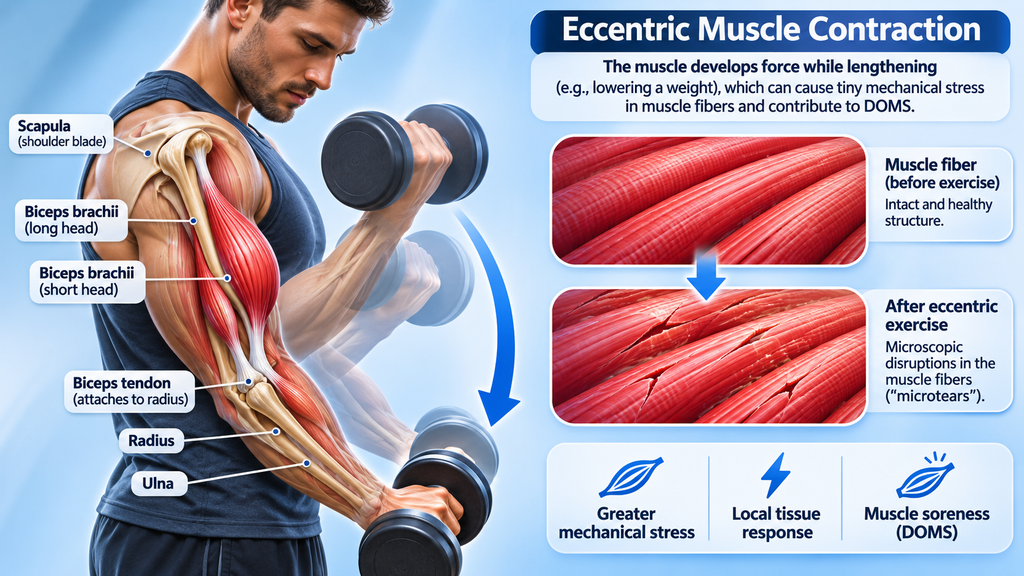
When lowering a dumbbell slowly, the elbow extends while the biceps brachii remains active to control the weight.
During this eccentric contraction, the muscle produces force while lengthening. Unfamiliar or high-volume eccentric loading can increase mechanical stress and the likelihood of DOMS.
However, muscle soreness does not necessarily indicate structural damage to muscle fibers.
Examples include:
- Descending into a squat.
- Lowering yourself from a pull-up.
- Running downhill.
- Controlling your landing after a jump.
However, eccentric exercise is not inherently harmful. When introduced progressively, it can improve strength, muscle function, and resistance to future exercise-induced soreness.
Is DOMS Caused by Lactic Acid?
No. Lactic acid accumulation is not responsible for delayed-onset muscle soreness.
During intense physical activity, lactate production increases as part of normal energy metabolism.
Lactate is also an important energy source that can be used by muscles and other tissues.
Blood lactate concentrations generally decline substantially after exercise, long before DOMS reaches its peak.
The burning sensation during a difficult exercise set is therefore different from the soreness experienced the following day.
The belief that lactic acid remains trapped inside muscles for several days is scientifically incorrect.
Does DOMS Mean Your Muscles Are Growing?
One of the most persistent fitness myths is that greater soreness means greater muscle growth.
DOMS is not a reliable indicator of muscle hypertrophy.
Muscle growth occurs through repeated resistance-training stimuli that promote adaptations in muscle protein synthesis and tissue remodeling.
Mechanical tension, appropriate training volume, progressive overload, adequate nutrition, and recovery are more important than how sore you feel.
A productive workout can stimulate muscle growth without causing noticeable soreness.
Conversely, an unfamiliar workout may produce substantial DOMS without providing an optimal stimulus for hypertrophy.
Research also demonstrates that muscle growth can occur without substantial evidence of exercise-induced muscle damage.
Rather than judging workout quality by pain, monitor improvements in strength, repetitions, exercise performance, and long-term progress.
DOMS vs. Muscle Injury: How to Recognize the Difference
Although DOMS can be uncomfortable, distinguishing it from an actual injury is essential.
DOMS typically develops gradually after unfamiliar exercise, causing widespread muscle tenderness, stiffness, and temporary discomfort during movement.
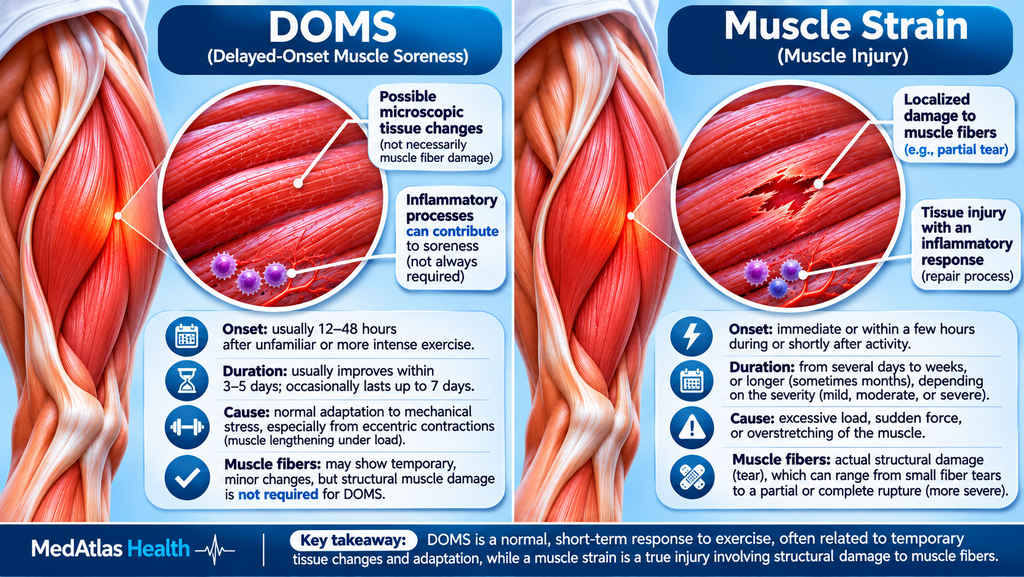
Symptoms usually improve over several days. A muscle strain, however, often causes sudden, localized pain during activity. It may involve swelling, bruising, reduced strength, or difficulty moving the affected muscle.
Unlike DOMS, a muscle strain involves actual structural injury to muscle tissue, ranging from minor damage to a more significant tear.
These differences are useful indicators, but they cannot independently confirm a diagnosis.
Persistent, worsening, or unusually severe symptoms require medical evaluation. For a closer look at training-related injuries and warning signs, read our guide to common gym injuries.
Can You Exercise With DOMS?
Mild DOMS does not necessarily mean you must stop exercising.
Light activity may be appropriate when soreness does not significantly affect movement, strength, or exercise technique. For example, someone experiencing mild quadriceps soreness may tolerate walking, gentle cycling, or upper-body training.
However, demanding exercise involving severely sore muscles should generally be postponed or modified.
Significant soreness may temporarily reduce strength, coordination, and range of motion, potentially compromising technique.
Feeling less sore does not always mean muscle function has fully recovered.
The safest approach is to adjust training intensity according to symptoms and physical performance rather than following rigid recovery timelines. Muscle soreness is not the only reason to adjust your training. If you are also feeling unwell, learn when to avoid exercise during a cold or fever.
How to Relieve DOMS and Support Muscle Recovery
There is no single treatment that reliably eliminates DOMS or guarantees faster physiological recovery.
However, several strategies may reduce discomfort and support normal recovery.
1. Gentle Movement and Active Recovery
Low-intensity movement, including walking, easy cycling, and comfortable mobility exercises, may temporarily relieve stiffness.
Activity should remain gentle and should not increase pain.
Although active recovery can improve perceived comfort, evidence that it substantially accelerates underlying muscle repair remains limited.
2. Adequate Sleep and Nutrition
Sleep plays an important role in normal physiological recovery and adaptation.
Adequate energy intake and protein consumption support muscle protein synthesis and tissue maintenance.
Carbohydrates help restore muscle glycogen after demanding exercise, particularly when training sessions are frequent.
Hydration is also important, especially following prolonged activity or substantial sweating.
However, excessive water consumption does not eliminate DOMS, and dehydration is not its primary cause.
3. Massage and Foam Rolling
Massage may provide short-term relief from soreness and perceived fatigue.
Some systematic reviews report improvements following massage and other recovery interventions, although study quality and treatment protocols vary.
Foam rolling may also improve comfort or range of motion, but evidence of its ability to accelerate physiological muscle recovery remains inconsistent.
Neither approach should involve aggressive pressure over severely painful or swollen muscles.
4. Heat and Cold Therapy
Warm showers or gentle heat may temporarily reduce discomfort and stiffness.
Cold-water immersion can also decrease perceived soreness after demanding exercise.
However, its effects depend on the exercise performed, treatment protocol, and outcome being measured.
Importantly, regular cold-water immersion immediately after resistance training may reduce some long-term strength and muscle-growth adaptations.
The certainty of evidence varies, so cold-water immersion is better considered an optional, situation-dependent recovery method rather than an essential post-workout routine.
5. Stretching and Pain Medication
Gentle stretching may feel comfortable, but scientific reviews show that stretching before or after exercise does not meaningfully prevent or reduce DOMS.
Pain-relieving medications are generally unnecessary for ordinary soreness.
Nonsteroidal anti-inflammatory drugs (NSAIDs), such as ibuprofen, may reduce pain in some circumstances but carry gastrointestinal, kidney, and other potential risks.
Routine medication use to manage normal exercise soreness is not recommended.
How Can You Prevent Severe DOMS?
The most effective prevention strategy is gradually introducing unfamiliar exercise demands.
Start new exercises with manageable loads and training volumes, then increase them progressively.
Repeated exposure to similar exercise often produces less soreness, a phenomenon known as the repeated-bout effect.
This adaptation involves changes in muscle and neuromuscular function that improve tolerance to subsequent loading.
Importantly, protective adaptations can develop without first experiencing severe soreness.
A sensible warm-up can prepare the body for exercise, but it does not reliably prevent DOMS.
Consistent training, progressive overload, and appropriate recovery are more useful than attempting to eliminate every episode of soreness.
When Is Muscle Pain After Exercise Dangerous?
Although DOMS is usually self-limiting, severe muscle pain can occasionally indicate a more serious condition.
One important example is exertional rhabdomyolysis, which involves extensive skeletal muscle breakdown and can cause kidney injury.
Warning signs include:
- Severe muscle pain that seems disproportionate to the activity.
- Pronounced muscle swelling.
- Significant weakness or difficulty moving.
- Dark, tea-colored or cola-colored urine.
- Reduced urine output.
Not everyone with rhabdomyolysis develops dark urine.
Seek urgent medical assessment if these symptoms occur, particularly after unusually strenuous exercise.
Severe pain accompanied by a tense, swollen limb or numbness also requires urgent evaluation because acute compartment syndrome may be possible.
Muscle pain that worsens progressively, lasts longer than expected, or interferes substantially with daily activities should be assessed by a healthcare professional.
Frequently Asked Questions
Is DOMS worse for beginners?
Often, because their muscles are less accustomed to specific training demands. However, experienced athletes can also develop significant soreness after unfamiliar exercise.
Can you build muscle without feeling sore?
Yes. Muscle hypertrophy does not require DOMS. Consistent resistance training, adequate nutrition, and recovery are more important.
Should you stretch sore muscles?
Gentle stretching is acceptable if comfortable, but it does not reliably accelerate recovery. Avoid forcing painful movements.
Does DOMS mean you need a rest day?
Not necessarily. Mild soreness may allow light activity or training unaffected muscles. More severe soreness warrants greater recovery and reduced training demands.
Final Thoughts
Delayed-onset muscle soreness is a common response to unfamiliar or demanding exercise. It involves interactions between mechanical stress, local tissue responses, inflammatory signaling, and increased sensitivity within the nervous system.
Although DOMS can be uncomfortable, it usually resolves naturally within several days.
Soreness does not determine workout effectiveness, and greater pain does not necessarily produce greater muscle growth.
The goal of exercise is progressive adaptation—not maximum soreness.
Training consistently, increasing demands gradually, and allowing appropriate recovery provide a more effective foundation for long-term strength, performance, and muscle health.
Sources & Further Reading
- Jemni M, et al. (2026). Rethinking Neurophysiology of Delayed Onset Muscle Soreness: Updated Concepts and Mechanisms for Mitigation Across Endurance, Resistance, and Plyometric Exercise.
- Hody S, et al. (2019). Eccentric Muscle Contractions: Risks and Benefits. Frontiers in Physiology.
- Damas F, Libardi CA, Ugrinowitsch C. (2018). The Development of Skeletal Muscle Hypertrophy Through Resistance Training: The Role of Muscle Damage and Muscle Protein Synthesis.
- Berjisian E, et al. (2026). Strategic Application of Post-exercise Cold-Water Immersion to Enhance Performance Recovery and Adaptation: An Umbrella Review of 15 Published Systematic Reviews with Meta-analysis.
- Herbert RD, de Noronha M, Kamper SJ. (2011). Stretching to Prevent or Reduce Muscle Soreness After Exercise. Cochrane Database of Systematic Reviews, CD004577.
Read on PubMed - Hayman O, et al. (2026). Neurophysiological and Neuromuscular Responses Associated With the Repeated Bout Effect Following Eccentric Exercise in Healthy Adults: A Systematic Review and Meta-analysis. European Journal of Applied Physiology.
Medical Disclaimer: This article is intended for educational purposes only and should not replace professional medical advice, diagnosis, or treatment.