
Every breath we take is part of a remarkable process that keeps the body alive. The lungs bring oxygen into the body, remove carbon dioxide from the bloodstream, and work together with the heart, blood vessels, muscles, and nervous system to maintain a constant supply of oxygen to our tissues.
But how exactly do the lungs work?
From the moment air enters the nose or mouth until oxygen reaches the bloodstream, several structures work together in a precisely coordinated process. In this guide, we will explore the anatomy of the lungs, how breathing works, how oxygen enters the blood, and how carbon dioxide is removed from the body.
Why Do We Need Lungs?
The lungs are the main organs of the respiratory system. Their most important function is gas exchange: bringing oxygen from the air into the bloodstream and removing carbon dioxide from the blood so it can be exhaled.
Oxygen is essential for the cells of the body because it is used to produce energy. As cells use oxygen, they produce carbon dioxide as a waste product. If carbon dioxide accumulates and oxygen cannot be supplied adequately, normal cellular function becomes impaired.
Breathing may feel automatic and effortless, but it depends on the coordinated activity of the respiratory muscles, airways, lungs, blood vessels, and nervous system.
Where Are the Lungs Located?
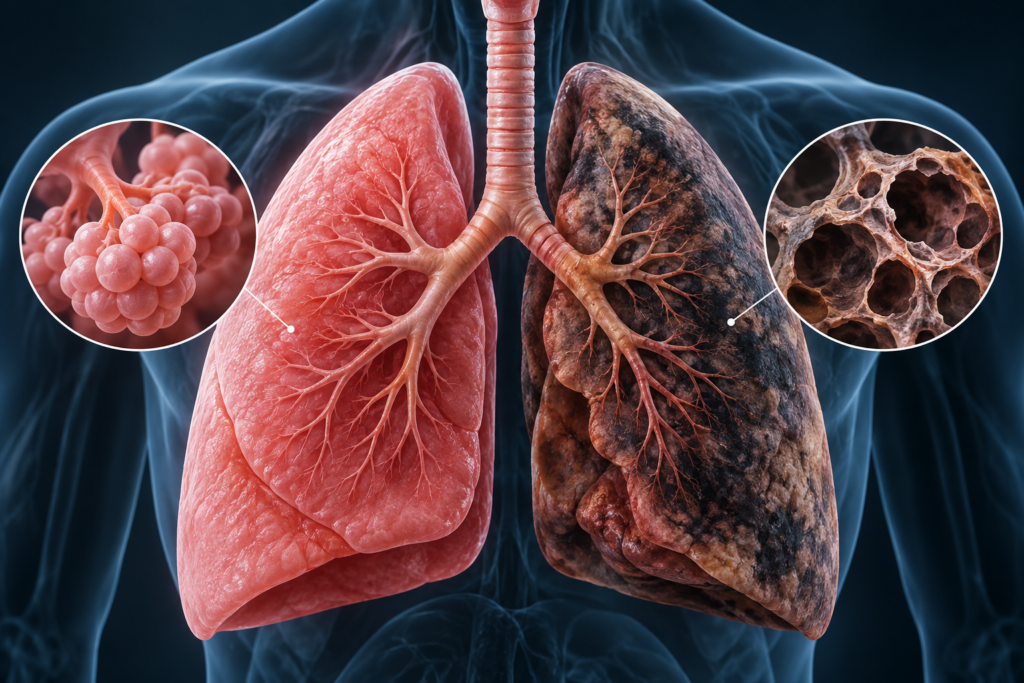
The lungs are located inside the chest, or thoracic cavity, on either side of the heart. They are protected by the rib cage and covered by a thin, double-layered membrane called the pleura.
The right lung has three lobes, while the left lung has two lobes. The left lung is slightly smaller because the heart occupies part of the space on the left side of the chest.
The lungs sit above the diaphragm, a large dome-shaped muscle that separates the chest cavity from the abdominal cavity. The diaphragm is the primary muscle involved in normal breathing.
The Anatomy of the Lungs
The respiratory system can be thought of as a branching network of airways that becomes progressively smaller as it travels deeper into the lungs.
The basic pathway of inhaled air is:
Nose or mouth → pharynx → larynx → trachea → bronchi → bronchioles → alveoli
The Trachea
The trachea, commonly called the windpipe, is the main airway connecting the upper respiratory tract with the lungs. It is supported by cartilage that helps keep the airway open.
The Bronchi
At its lower end, the trachea divides into two main airways called the right and left main bronchi. Each bronchus carries air toward one lung.
Inside the lungs, the bronchi continue to branch into smaller airways.
The Bronchioles
The smaller branches are called bronchioles. They distribute air throughout the lungs and eventually lead toward the respiratory structures where gas exchange occurs.
The Alveoli
At the end of the smallest respiratory airways are millions of microscopic air sacs called alveoli.
The alveoli are the primary site of gas exchange. Each alveolus is surrounded by a network of tiny blood vessels called capillaries, creating a very close connection between inhaled air and circulating blood.
How Does Breathing Work?
Breathing consists of two basic phases: inhalation and exhalation.
Inhalation: Breathing In
When you inhale, the diaphragm contracts and moves downward. At the same time, the muscles between the ribs help expand the chest cavity.
As the volume of the chest cavity increases, the lungs expand and air flows into them.
The air travels through the airways and eventually reaches the alveoli.
Exhalation: Breathing Out
During normal exhalation, the diaphragm and other inspiratory muscles relax. The chest cavity becomes smaller and the elastic properties of the lungs help them recoil.
This pushes air out of the lungs.
The exhaled air contains more carbon dioxide and less oxygen than the air that was inhaled.
During exercise or other situations when breathing becomes more forceful, additional respiratory muscles can help increase the speed and depth of breathing.
Conclusion
The lungs are much more than simple organs that fill with air.
Every breath involves a coordinated system of airways, respiratory muscles, alveoli, blood vessels, and the nervous system. Air travels through the respiratory tract until it reaches the alveoli, where oxygen enters the blood and carbon dioxide leaves it.
In simple terms: you breathe in oxygen, your lungs transfer it into the blood, your body uses it, and your lungs remove the carbon dioxide produced along the way.
That continuous process happens thousands of times every day—usually without us even thinking about it.
One Comment
Comments are closed.