Understanding how hearing works begins with something surprisingly simple: vibration. Every sound you hear—from a voice and ringing phone to music, footsteps, or rain—starts as a pressure wave traveling through the air.
A voice, a ringing phone, music, footsteps, or the sound of rain all create pressure waves that travel through the air. But these waves are not yet “hearing.” Before your brain can recognize a voice or understand a word, your auditory system must perform an extraordinary transformation.
Within fractions of a second, the ear collects sound waves, converts them into mechanical vibrations, transfers those vibrations into fluid movement, and finally turns that movement into electrical signals that the brain can interpret.
Here is what happens inside your ears every time you hear a sound.
Hearing Begins With Sound Waves
Sound is created when an object vibrates and causes nearby air molecules to move.
These changes in air pressure spread outward as sound waves. Two important characteristics of these waves are frequency and amplitude.
Frequency, measured in hertz (Hz), influences how high or low a sound appears. Higher-frequency vibrations generally produce higher-pitched sounds, while lower frequencies produce deeper sounds.
Amplitude relates to the intensity of the sound and contributes to how loud we perceive it.
Your auditory system must capture these pressure changes and convert them into information the nervous system can understand.
That process begins with the outer ear.
Step 1: The Outer Ear Collects Sound
The visible part of your ear is called the pinna, or auricle.
Its curved shape helps collect sound waves from the environment and direct them into the external auditory canal, commonly called the ear canal.
Sound waves then travel through this canal until they reach a thin membrane separating the outer and middle ear: the tympanic membrane, better known as the eardrum.
The outer ear does more than simply collect sound. Its shape also contributes to our ability to determine where sounds are coming from, especially when combined with information from both ears.
Step 2: The Eardrum Turns Sound Into Movement
When sound waves reach the eardrum, changing air pressure causes it to vibrate.
At this point, airborne sound energy has been converted into mechanical movement.
Different sounds produce different patterns of vibration. The auditory system preserves information contained in these vibrations as the signal continues deeper into the ear.
But the eardrum does not work alone. Directly behind it sits one of the smallest and most precise mechanical systems in the human body.
Step 3: Three Tiny Bones Transfer the Vibrations
Inside the middle ear are three tiny interconnected bones known collectively as the auditory ossicles:
- Malleus — the hammer
- Incus — the anvil
- Stapes — the stirrup
The malleus is connected to the eardrum. When the eardrum moves, the malleus moves with it, transferring the vibration to the incus and then to the stapes.
The stapes is the smallest bone in the human body.
Its movement transfers mechanical energy into the inner ear through a membrane-covered opening called the oval window.
This middle-ear system helps efficiently transfer vibrations from air into the fluid-filled inner ear.
And this is where hearing becomes even more remarkable.
Step 4: Vibrations Enter the Cochlea
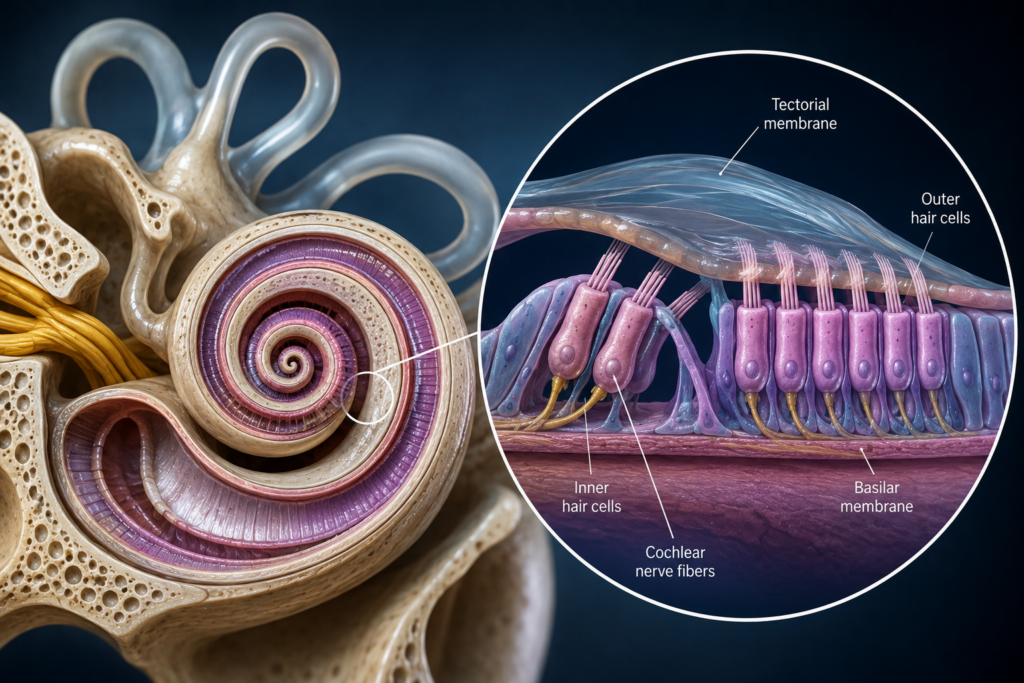
Behind the oval window lies the cochlea, a tiny spiral-shaped structure resembling a snail shell.
Unlike the air-filled middle ear, the cochlea contains fluid.
When the stapes moves against the oval window, it creates pressure waves within this fluid. These waves travel through the cochlea and cause an internal flexible structure called the basilar membrane to move.
Different regions of the basilar membrane respond most strongly to different sound frequencies.
Higher-frequency sounds produce their strongest response closer to the base of the cochlea, while lower-frequency sounds peak farther along the cochlear spiral.
This spatial organization is known as tonotopy.
In other words, the cochlea performs a kind of biological frequency analysis before the information even reaches the brain.
Step 5: Hair Cells Convert Movement Into Electrical Signals
Sitting within the cochlea is the organ of Corti, which contains specialized sensory cells known as hair cells.
Despite their name, these cells do not contain actual hairs. Instead, their upper surfaces contain microscopic projections called stereocilia.
As sound-driven waves move the structures inside the cochlea, the stereocilia bend.
That tiny movement is crucial.
Bending the stereocilia opens mechanically sensitive ion channels. Changes in ion flow alter the electrical state of the hair cell, allowing mechanical vibration to be converted into an electrochemical signal.
This process is called mechanotransduction.
The inner ear therefore performs one of the central transformations involved in hearing:
Mechanical energy → electrical information
There are two major types of cochlear hair cells.
Inner hair cells provide most of the sensory information that is transmitted toward the brain.
Outer hair cells actively influence cochlear mechanics, helping increase sensitivity and sharpen frequency discrimination.
Together, these microscopic cells allow the auditory system to detect an enormous variety of sounds.
Step 6: The Auditory Nerve Carries the Message
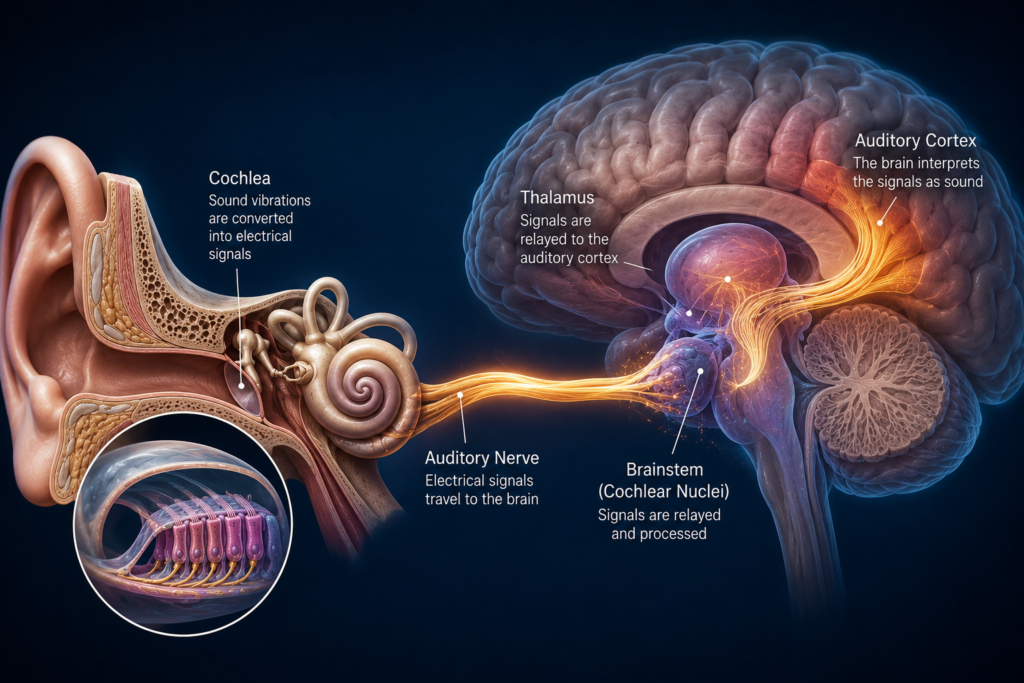
Once hair cells respond to movement inside the cochlea, they communicate with nearby auditory nerve fibers.
These signals travel through the cochlear portion of the vestibulocochlear nerve (cranial nerve VIII).
But the auditory nerve does not simply transmit an electronic copy of the original sound wave.
Instead, information about characteristics such as frequency, intensity, and timing is represented through patterns of neural activity.
The signal then travels through several processing stations within the brainstem and other parts of the auditory pathway before eventually reaching the auditory cortex.
Step 7: The Brain Turns Signals Into Meaning
Your ears detect and encode sound, but the conscious experience of hearing depends on the brain.
Auditory information eventually reaches the auditory cortex, located primarily within the temporal lobes.
Here, neural activity is analyzed and integrated with information from other brain regions.
This allows you not only to detect a sound but also to interpret it.
A complex pattern of vibrations can become:
a familiar voice,
a sentence,
a warning alarm,
a musical melody,
or the sound of someone approaching from behind.
The brain also uses previous experience and context to help determine what sounds mean.
So although we commonly say that we “hear with our ears,” hearing is actually the result of a continuous partnership between the ear and the brain.
How Two Ears Help You Locate Sound
Having two ears provides another major advantage: sound localization.
If a sound originates on your right side, it usually reaches your right ear slightly earlier and often with a different intensity than it reaches your left ear.
The brain can compare these extremely small differences in timing and sound level.
Combined with other acoustic cues, this allows it to estimate where a sound originated.
This ability helps us navigate our environment, follow conversations, and rapidly identify important sounds around us.
Why Loud Noise Can Damage Hearing
The extraordinary sensitivity of the inner ear also makes it vulnerable.
Exposure to sufficiently loud sound can damage the delicate structures involved in hearing, particularly cochlear hair cells and their stereocilia.
Damage may occur gradually after repeated exposure to excessive noise or more suddenly after extremely intense sound.
The important problem is that damaged human cochlear hair cells do not normally regenerate in a way that restores hearing.
As more sensory cells become damaged or lost, hearing can become less sensitive or sounds may become distorted.
This is why protecting your hearing from excessive noise is important even when your hearing currently seems normal.
What Happens When Part of the System Fails?
Because hearing involves several different structures, hearing loss can occur at different stages of the pathway.
Conductive hearing loss occurs when sound is not efficiently transmitted through the outer or middle ear. Problems involving the ear canal, eardrum, or ossicles can contribute to this type of hearing loss.
Sensorineural hearing loss involves damage or dysfunction within the inner ear or auditory nerve and is often associated with cochlear hair-cell damage.
Some disorders can also interfere with how auditory information is transmitted or processed even when parts of the ear can still detect sound.
The location and cause of the problem therefore determine how hearing is affected and which treatments may be appropriate.
From Vibration to Perception
What feels instantaneous is actually a sophisticated biological chain reaction.
A sound begins as a pressure wave in the environment.
The outer ear collects it.
The eardrum begins to vibrate.
The ossicles transfer those vibrations.
The cochlea turns them into waves within fluid.
Hair cells convert mechanical movement into electrical signals.
The auditory nerve carries those signals toward the brain.
And the brain transforms neural activity into something meaningful.
Sound wave → vibration → fluid movement → hair-cell activation → nerve signal → perception
Every conversation, song, alarm, and whisper you hear depends on this remarkable sequence happening continuously and with extraordinary precision.
Your ears capture the vibrations.
Your nervous system carries the information.
But ultimately, your brain is what turns sound into hearing.
Frequently Asked Questions
Where does hearing actually happen?
The ear captures and converts sound into neural signals, while the brain processes those signals to create the conscious perception and interpretation of sound. Hearing therefore depends on both the auditory organs and the brain.
What is the cochlea?
The cochlea is a spiral-shaped, fluid-filled structure within the inner ear. It contains the sensory structures responsible for converting sound-induced mechanical movement into signals that can be transmitted to the nervous system.
What are hair cells?
Hair cells are specialized sensory cells located within the inner ear. Their stereocilia respond to mechanical movement, allowing sound vibrations to be converted into electrochemical signals.
What is the smallest bone in the human body?
The stapes, one of the three middle-ear ossicles, is the smallest bone in the human body.
Can damaged inner-ear hair cells grow back?
In humans, damaged cochlear hair cells generally do not regenerate sufficiently to restore normal hearing. This is one reason noise-induced hearing loss can be permanent.
Why do we have two ears?
Two ears allow the brain to compare differences in the timing and intensity of sounds reaching each side, helping determine where sounds originate.
Medical Disclaimer: This article is intended for general educational purposes and does not replace professional medical evaluation, diagnosis, or treatment.
MedAtlas Health — Your Visual Guide to Medicine and Health