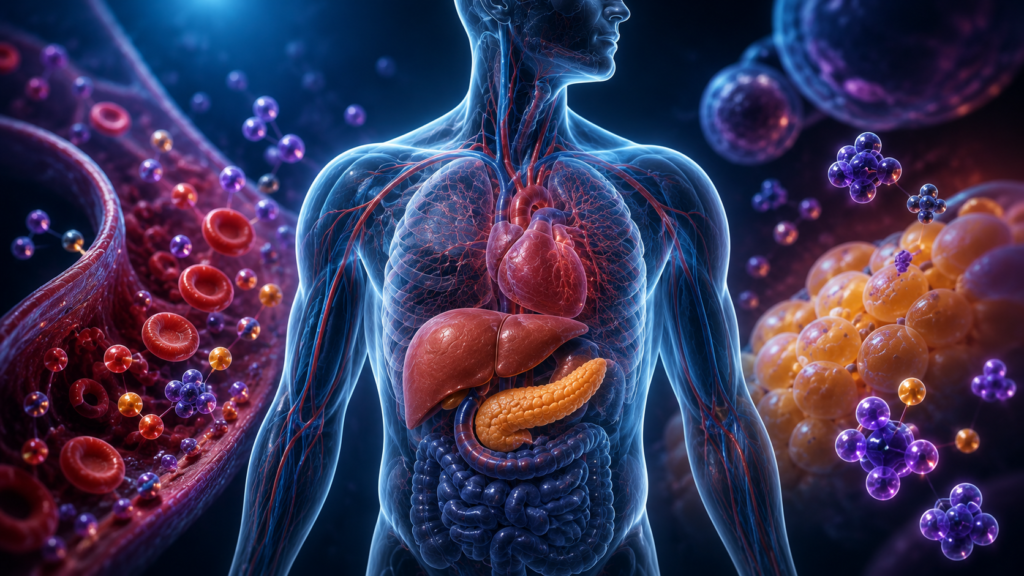
Atherosclerosis is often described simply as “clogged arteries.” But what happens inside an artery is far more complex.
Plaque does not suddenly appear, nor is it simply a layer of fat sticking to the inside of a blood vessel. Atherosclerosis is a slow, progressive disease involving cholesterol, inflammation, immune cells, and changes within the artery wall itself.
The process can begin years or even decades before symptoms appear. Over time, plaque can narrow an artery and restrict blood flow. More dangerously, an unstable plaque can rupture and trigger the formation of a blood clot — potentially leading to a heart attack or stroke.
So how does a healthy artery gradually develop atherosclerosis?
Let’s follow the process from the inside.
What Is Atherosclerosis?
Atherosclerosis is a disease in which plaque develops within the walls of arteries — the blood vessels that carry blood from the heart to tissues throughout the body.
Atherosclerotic plaque can contain:
- cholesterol and other lipids
- inflammatory and immune cells
- cellular debris
- connective tissue
- calcium
As the disease progresses, the artery wall may become thicker and less flexible, while some plaques can protrude into the vessel and reduce the space available for blood flow.
Atherosclerosis can affect arteries throughout the body.
When it involves the coronary arteries, it contributes to coronary artery disease. In arteries supplying the brain, it can contribute to stroke. In arteries of the legs, it can cause peripheral artery disease.
But before any of these complications occur, important microscopic changes have already been taking place inside the arterial wall.
How Does Plaque Begin to Form?
Step 1: The Endothelium Becomes Dysfunctional
The inner surface of an artery is covered by a thin layer of cells called the endothelium.
A healthy endothelium helps regulate blood vessel tone, inflammation, blood clotting, and the movement of substances between the bloodstream and the artery wall.
Several cardiovascular risk factors can interfere with normal endothelial function.
These include:
- high blood pressure
- elevated levels of atherogenic lipoproteins
- smoking
- diabetes and high blood glucose
- chronic inflammatory conditions
When endothelial function becomes impaired, the artery wall becomes more susceptible to the processes that drive atherosclerosis.
Step 2: LDL Particles Enter the Artery Wall
Low-density lipoprotein, or LDL, transports cholesterol through the bloodstream.
LDL itself has an important physiological role, but prolonged exposure to excessive concentrations of LDL and other atherogenic lipoproteins increases the likelihood that these particles will enter and become retained within the arterial wall.
Once trapped beneath the endothelium, these particles can undergo chemical modifications.
The immune system begins to recognize the affected area as abnormal.
Inflammation Enters the Picture
Atherosclerosis is not simply a cholesterol-storage problem.
It is also a chronic inflammatory process.
Signals from the affected artery wall attract circulating immune cells, particularly monocytes.
These cells move through the endothelium and enter the arterial wall, where they develop into macrophages.
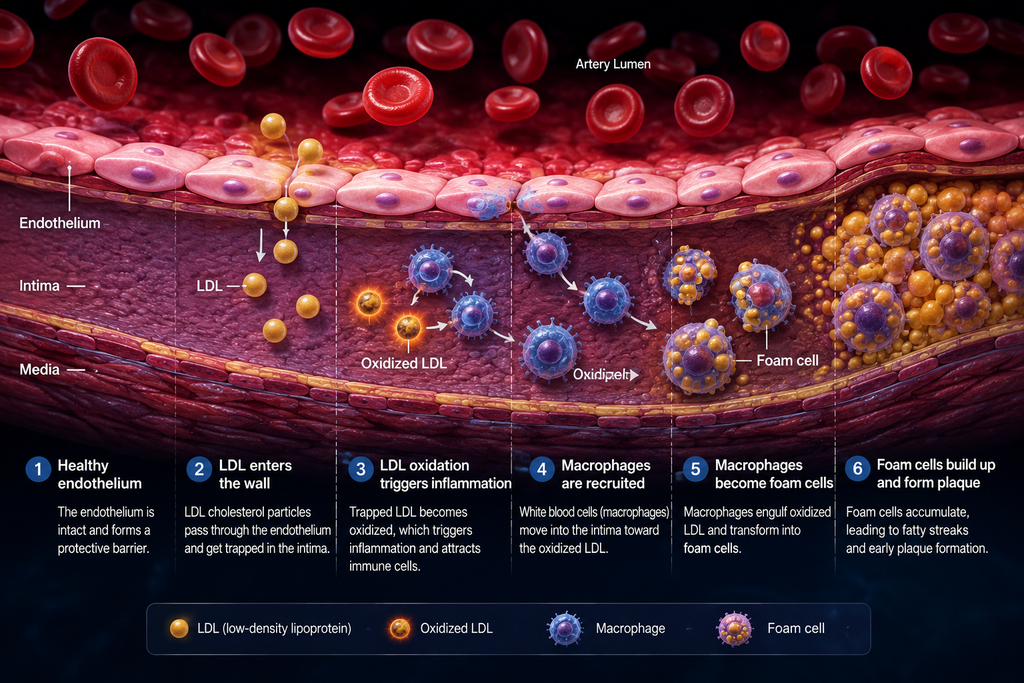
Macrophages act as cellular “clean-up” cells.
They begin taking up modified lipid particles.
But when large amounts of cholesterol accumulate inside them, the macrophages become swollen with lipid droplets.
These cholesterol-filled cells are known as foam cells.
From Foam Cells to a Fatty Streak
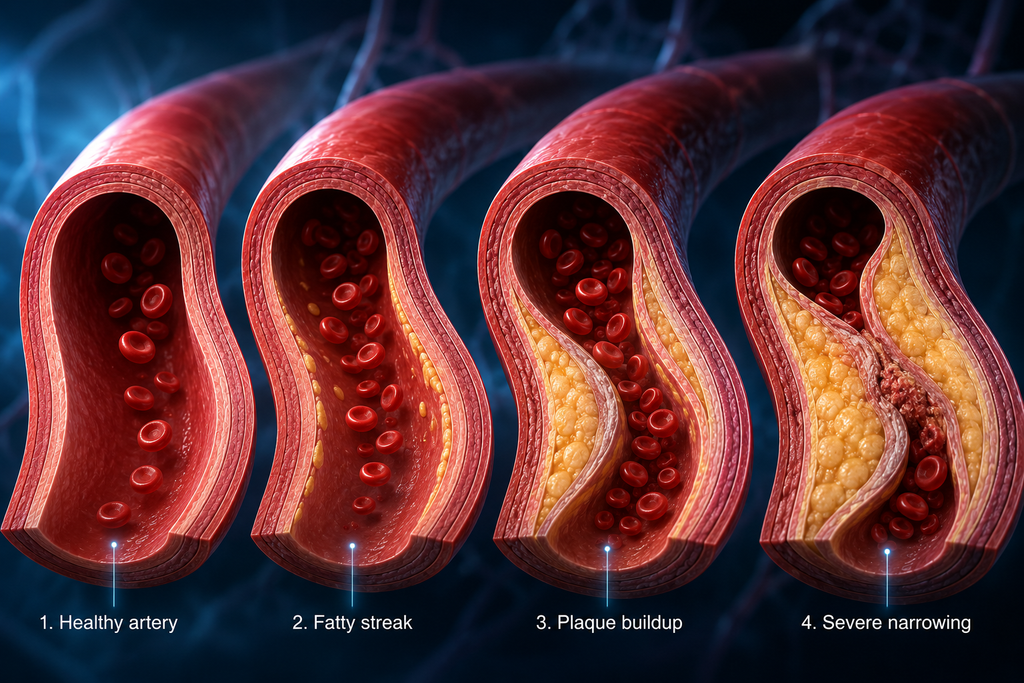
Clusters of foam cells create one of the earliest visible forms of atherosclerosis: the fatty streak.
Fatty streaks can develop relatively early in life and do not necessarily produce symptoms.
At this stage, blood may still flow through the artery without significant obstruction.
However, if the conditions promoting atherosclerosis continue, the lesion can progress.
More lipids accumulate.
More inflammatory cells arrive.
Cells within the artery wall respond to the ongoing injury.
The structure of the artery gradually begins to change.
How a Mature Atherosclerotic Plaque Develops
As the lesion progresses, smooth muscle cells from deeper layers of the artery can migrate toward the developing plaque.
These cells contribute to the production of collagen and other components of connective tissue.
Eventually, the plaque develops two important structural regions.
The Lipid-Rich Core
The central portion can contain cholesterol, lipid material, inflammatory cells, and cellular debris.
This is sometimes called the necrotic or lipid-rich core.
The Fibrous Cap
Above this core, connective tissue forms a covering known as the fibrous cap.
The cap separates the highly thrombogenic material inside the plaque from circulating blood.
This distinction becomes extremely important because not all plaques behave the same way.
What Happens to Blood Flow?
As some plaques enlarge, they can gradually narrow the arterial lumen — the open channel through which blood flows.
To understand why narrowing an artery matters, it helps to understand how blood normally travels through the cardiovascular system.
This narrowing is called stenosis.
At rest, a moderately narrowed artery may still provide enough blood to the tissue it supplies.
Problems may become noticeable when the tissue requires more oxygen.
For example, if a coronary artery is significantly narrowed, the heart may receive adequate blood while a person is resting but struggle to receive enough oxygen-rich blood during physical exertion.
This mismatch between oxygen supply and demand can produce myocardial ischemia and symptoms such as angina.
However, the percentage of narrowing is only part of the story.
The biological stability of the plaque can be just as important.
Stable vs. Vulnerable Plaque
A common misconception is that the plaque causing the greatest narrowing must always be the most dangerous.
That is not necessarily true.
Some plaques have a relatively thick, strong fibrous cap and may remain stable for long periods.
Other plaques may contain a larger lipid-rich core, substantial inflammation, and a thinner fibrous cap. These are more susceptible to disruption.
If the protective surface of a plaque breaks, the consequences can develop rapidly.
What Happens When Plaque Ruptures?
When a plaque ruptures, material that was previously isolated from circulating blood becomes exposed.
The body interprets the damaged surface as an injury.
Platelets become activated and accumulate at the site, while the coagulation system contributes to the formation of a thrombus — a blood clot.
Depending on its size and location, the thrombus may partially or completely block the artery.
This is one reason atherosclerosis can remain relatively silent for years and then suddenly cause a medical emergency.
In a coronary artery:
An acute blockage can interrupt blood flow to part of the heart muscle and cause a myocardial infarction (heart attack). A heart attack and sudden cardiac arrest are not the same condition, although a heart attack can sometimes trigger cardiac arrest.
In arteries supplying the brain:
An arterial blockage can interrupt blood flow to brain tissue and cause an ischemic stroke.
The dangerous event, therefore, is not always the gradual narrowing itself.
Sometimes it is the sudden transition from a relatively stable plaque to an acute blood clot.
Where Can Atherosclerosis Develop?
Although coronary atherosclerosis receives much attention, the disease is systemic and can affect many arterial territories.
Coronary arteries: reduced blood flow can contribute to angina, coronary artery disease, and myocardial infarction.
Carotid and cerebral circulation: atherosclerotic disease can contribute to transient ischemic attacks and stroke.
Peripheral arteries: reduced circulation, particularly in the legs, can cause peripheral artery disease.
Renal arteries: narrowing of arteries supplying the kidneys can contribute to renal artery stenosis and difficult-to-control hypertension.
A person may therefore have atherosclerotic disease in more than one part of the cardiovascular system.
Why Can Atherosclerosis Be Silent for Years?
One of the most important characteristics of atherosclerosis is its long subclinical phase.
Early plaque usually does not produce noticeable symptoms.
In addition, arteries can initially remodel as plaque develops, partly preserving the size of the lumen.
Symptoms may therefore appear only after the disease has become more advanced — or when an acute complication occurs.
This is why cardiovascular risk assessment matters even when someone feels completely healthy.
Major Risk Factors for Atherosclerosis
Atherosclerosis develops through an interaction between lipoproteins, vascular biology, inflammation, lifestyle, genetics, and other health conditions.
Important risk factors include:
- elevated LDL cholesterol and other atherogenic lipoproteins
- high blood pressure
- smoking
- diabetes
- increasing age
- family history and genetic factors
- low physical activity
- dietary patterns associated with increased cardiovascular risk
- certain chronic inflammatory diseases
Lipoprotein(a), or Lp(a), is another important cardiovascular risk factor. Its level is largely genetically determined, and elevated Lp(a) is associated with increased risk of atherosclerotic cardiovascular disease.
Having several risk factors at the same time can substantially increase overall cardiovascular risk.
How Is Atherosclerosis Detected?
There is no single test appropriate for every person.
Doctors first consider medical history, family history, symptoms, blood pressure, cholesterol levels, blood glucose, smoking history, and overall cardiovascular risk.
Depending on the clinical situation, additional tests may include:
Blood Tests
A lipid profile can measure LDL cholesterol, HDL cholesterol, and triglycerides. Other tests may sometimes include lipoprotein(a) or apolipoprotein B.
Coronary Artery Calcium Scan
A non-contrast CT scan can detect and quantify calcium within coronary arteries.
The resulting coronary artery calcium (CAC) score can help refine cardiovascular risk assessment in selected patients.
CT Coronary Angiography
CT coronary angiography can provide detailed images of the coronary arteries and can identify plaque and arterial narrowing.
Ankle-Brachial Index
The ankle-brachial index compares blood pressure measured at the ankle with blood pressure in the arm and can help identify peripheral artery disease.
Other tests may be used depending on symptoms and which arteries are suspected to be affected.
Can Atherosclerosis Be Prevented or Slowed?
Atherosclerosis develops over many years, which also means there are many opportunities to reduce cardiovascular risk.
Prevention focuses on reducing exposure to the factors that promote arterial injury and plaque formation.
Important measures include:
- not smoking
- maintaining healthy blood pressure
- managing cholesterol and other atherogenic lipoproteins
- controlling diabetes when present
- being physically active
- following a heart-healthy dietary pattern
- maintaining regular medical follow-up when cardiovascular risk factors are present
Medication may also be necessary depending on an individual’s cardiovascular risk and medical history.
The Bigger Picture: Atherosclerosis Is More Than a Clogged Pipe
Perhaps the most useful way to understand atherosclerosis is to stop imagining arteries as simple plumbing.
Plaque is not merely fat sticking to the inside of a tube.
Atherosclerosis is a dynamic biological process involving atherogenic lipoproteins, endothelial dysfunction, immune activation, inflammation, tissue remodeling, and thrombosis.
The process can develop silently over decades.
And although gradual narrowing can reduce blood flow, one of the most dangerous moments occurs when a plaque becomes disrupted and a blood clot suddenly forms.
Understanding this process explains why controlling cardiovascular risk factors long before symptoms appear is so important.
A heart can appear strong while underlying cardiovascular changes still affect its long-term health.
Frequently Asked Questions
Is atherosclerosis the same as arteriosclerosis?
No. Arteriosclerosis is a broad term describing thickening and loss of elasticity of arteries. Atherosclerosis is a specific form of arterial disease characterized by the development of lipid-rich plaque within the artery wall.
Does eating fat directly clog your arteries?
No. The process is much more complex. Dietary patterns can influence blood lipids and cardiovascular risk, but atherosclerotic plaque develops within the artery wall through interactions involving lipoproteins, inflammation, immune cells, vascular cells, and other factors.
Can atherosclerosis occur without symptoms?
Yes. Early and even moderately advanced atherosclerosis may cause no noticeable symptoms. Some people first become aware of the disease only after a cardiovascular complication or diagnostic testing.
Can young people develop atherosclerosis?
Early atherosclerotic changes can begin much earlier in life than most people realize. Clinical complications are far more common later, but lifetime exposure to cardiovascular risk factors influences how the disease progresses.
Can plaque disappear completely?
Atherosclerosis is treatable, and intensive risk-factor management can slow progression, stabilize plaques, and in some circumstances produce some regression of plaque burden. The primary clinical goal is to reduce the risk of heart attack, stroke, and other cardiovascular complications.
Why can a small plaque cause a heart attack?
The severity of an acute event is not determined only by how much an artery was narrowed beforehand. If a vulnerable plaque becomes disrupted, rapid formation of a thrombus can suddenly obstruct blood flow.
Final Takeaway
Atherosclerosis is a slow process that can begin long before symptoms develop.
It starts with changes within the arterial wall. Atherogenic lipoproteins become retained, inflammation attracts immune cells, foam cells accumulate, and a fatty streak can gradually develop into a mature plaque.
Some plaques progressively restrict blood flow.
Others may become unstable and rupture, triggering a blood clot capable of suddenly blocking an artery.
That is why preventing atherosclerosis is not simply about avoiding “clogged arteries.” It is about protecting the health of the entire cardiovascular system throughout life.
This article is for educational purposes only and is not a substitute for professional medical advice, diagnosis, or treatment.