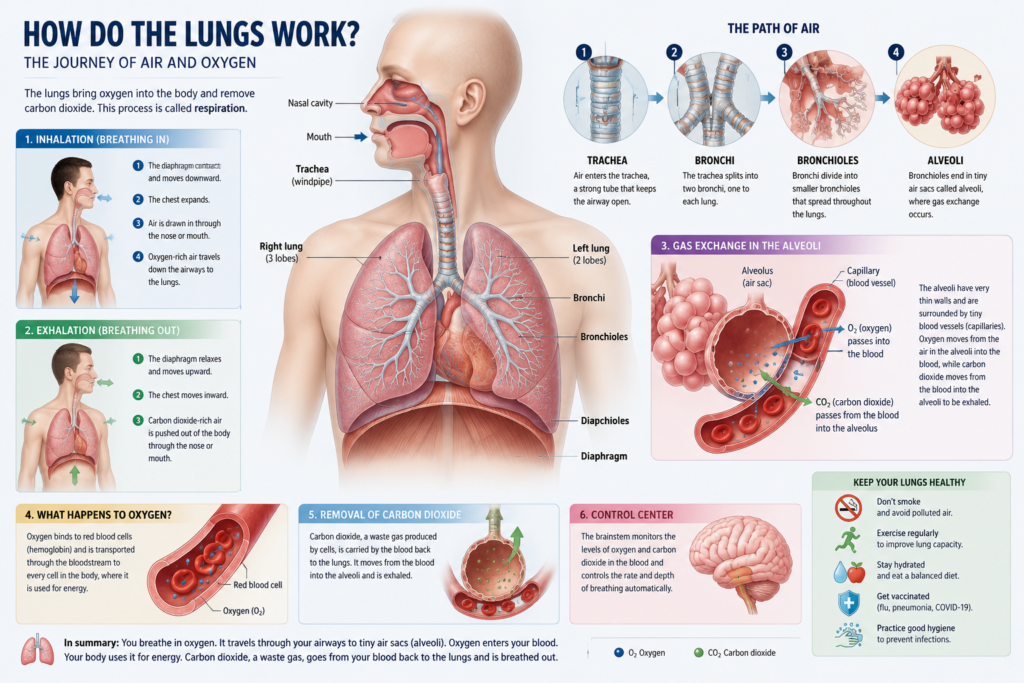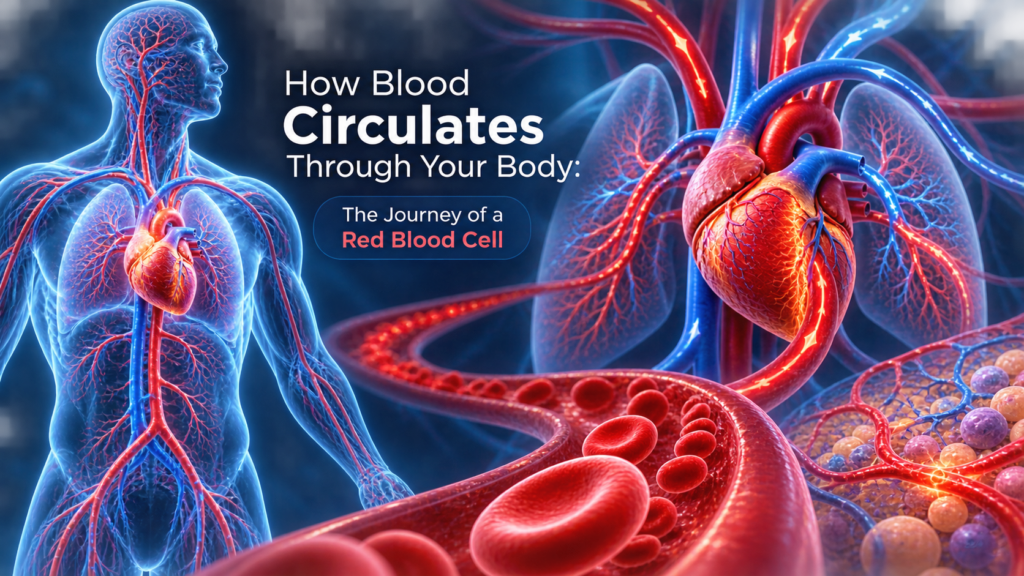
Understanding how smoking damages your lungs starts with what happens the moment cigarette smoke enters your airways. Every cigarette exposes the respiratory system to a complex mixture of chemicals and particles that can affect the airways, cilia, alveoli, and other structures responsible for healthy breathing.
Cigarette smoke affects the airways, protective cilia, mucus-producing cells, immune system, alveoli, and lung tissue. With continued exposure, inflammation can become chronic, airflow may become increasingly restricted, and some structural changes can eventually become irreversible.
Understanding how smoking damages your lungs means looking beyond the visible smoke and following what happens from the moment it enters the airways.
What Happens When Cigarette Smoke Enters Your Lungs?
When cigarette smoke is inhaled, it travels through the mouth and throat, down the trachea and into progressively smaller bronchi and bronchioles.
Unlike normal inhaled air, cigarette smoke contains thousands of chemicals. Some are toxic, and many are known carcinogens. CDC describes tobacco smoke as containing more than 7,000 chemicals, including substances capable of damaging DNA and promoting cancer.
The respiratory tract has several defense mechanisms designed to protect delicate lung tissue from particles and microorganisms.
Repeated exposure to cigarette smoke can overwhelm and impair these defenses.
The result is not simply “dirty lungs.” It is a biological response involving irritation, inflammation, oxidative stress, altered mucus production, impaired clearance of inhaled material, and progressive tissue injury.
How Smoking Damages Your Lungs: The Role of Cilia
To understand how smoking damages your lungs, it is important to consider what happens to the cilia and the lung’s natural cleaning system.
The inner surface of much of the respiratory tract is lined with microscopic hair-like structures called cilia. Together with mucus, they form an important protective system.
Mucus traps dust, microorganisms, and inhaled particles. Coordinated movement of the cilia then helps transport this material upward toward the throat, where it can be swallowed or expelled.
Cigarette smoke interferes with this clearance system.
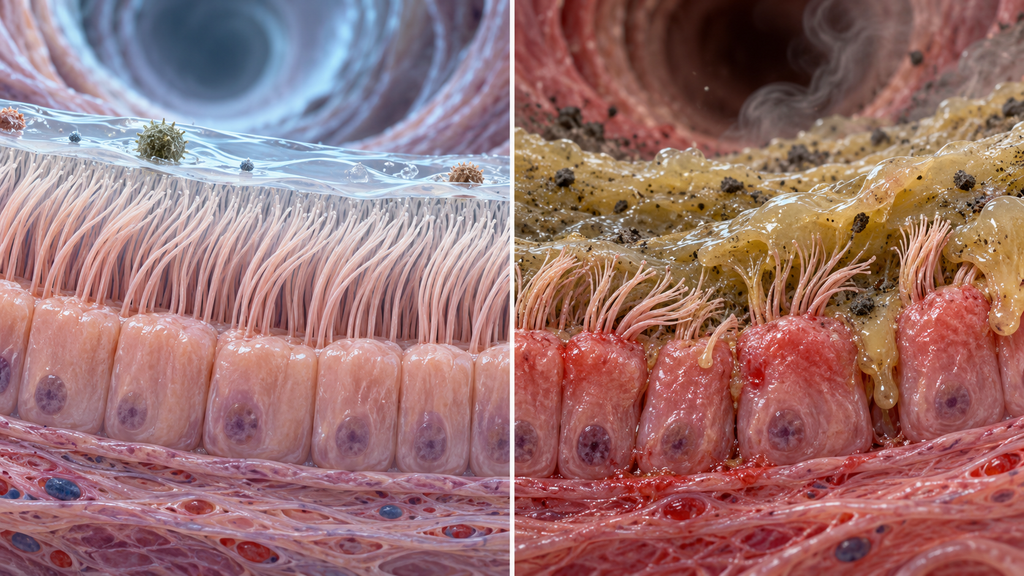
When mucociliary function becomes impaired, mucus and inhaled material are more difficult to remove efficiently. At the same time, smoking can promote greater mucus production and chronic airway irritation. This helps explain why persistent coughing and sputum production are common among long-term smokers.
A cough may therefore become one of the mechanisms the body relies on to clear material that healthy mucociliary defenses would normally help remove.
Smoking Creates Chronic Inflammation in the Airways
Inflammation is normally a protective response to injury or infection.
The problem develops when the damaging exposure continues.
With repeated cigarette smoke exposure, inflammatory cells and signaling molecules can remain active within the respiratory system. Instead of resolving completely, inflammation may become chronic.
Over time, the walls of the airways can become irritated, swollen, and structurally altered.
This matters because air must travel through these passages every time you breathe.
As airway resistance increases and the small airways become damaged, moving air — particularly during exhalation — can become progressively more difficult.
CDC describes airway inflammation and thickening as one of the mechanisms responsible for reduced airflow in COPD.
Why Smoking Causes More Mucus and Chronic Cough
The respiratory system normally produces mucus for a reason. It helps trap unwanted material before it reaches deeper lung tissue.
But chronic exposure to cigarette smoke can disturb this balance.
Mucus-producing structures may become enlarged or more active, while the mechanisms responsible for clearing mucus become less effective.
The combination is problematic:
more mucus + impaired clearance + narrowed inflamed airways
This contributes to the characteristic productive cough experienced by many long-term smokers.
When chronic productive cough is associated with persistent airway inflammation and airflow problems, it can form part of the clinical picture of chronic bronchitis.
Chronic bronchitis is one of the major conditions included under the broader term chronic obstructive pulmonary disease (COPD).
How Smoking Damages the Alveoli
The most serious effects of smoking occur deeper inside the lungs.
At the ends of the smallest airways are millions of microscopic air sacs called alveoli.
This is where gas exchange occurs.
Oxygen crosses the thin alveolar-capillary barrier and enters the bloodstream, while carbon dioxide moves in the opposite direction so it can be exhaled.
The enormous combined surface area of healthy alveoli makes this process highly efficient.
Long-term cigarette smoking can damage the walls separating these tiny air spaces.
As alveolar walls are destroyed, many small functional air spaces can effectively become larger, less efficient spaces. The lung loses some of its gas-exchange surface area and its normal elastic recoil. This process is characteristic of emphysema.
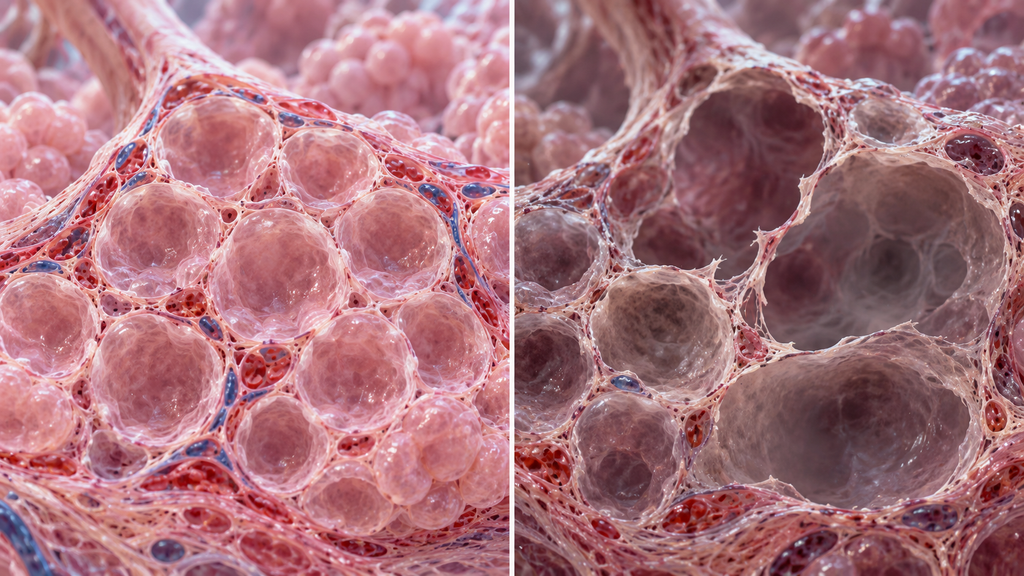
Healthy alveoli contain many small air sacs that provide a large surface area for gas exchange. In emphysema, destruction of the alveolar walls creates larger air spaces and reduces the lungs’ ability to efficiently exchange oxygen and carbon dioxide. Unlike temporary airway irritation, destruction of alveolar architecture is not fully reversible.
This distinction is important when discussing whether the lungs can recover after someone stops smoking.
For a more detailed explanation of normal alveoli and gas exchange, see our guide How Do the Lungs Work?
From Healthy Lungs to COPD
Another important part of understanding how smoking damages your lungs is recognizing how chronic airway inflammation and alveolar destruction can eventually contribute to COPD
Chronic obstructive pulmonary disease is not a single anatomical abnormality.
It involves persistent airflow limitation associated with changes in the airways and/or alveoli.
Smoking is one of the major causes of COPD. CDC estimates that cigarette smoking accounts for as many as 8 in 10 COPD-related deaths in the United States.
Several smoking-related processes can occur together:
chronic airway inflammation
↓
increased mucus production
↓
small-airway narrowing and remodeling
↓
alveolar destruction and loss of elastic recoil
↓
persistent airflow limitation
As COPD progresses, people may experience chronic cough, sputum production, wheezing, reduced exercise tolerance, and shortness of breath.
Breathing can become particularly difficult during physical activity because the respiratory system must increase ventilation precisely when airflow is already limited.
Importantly, not every smoker develops clinically significant COPD, and COPD can occur in people who have never smoked. Genetics, occupational exposures, air pollution, early-life factors, and other influences can also contribute.
Smoking and Lung Cancer: What Happens at the Cellular Level?
Smoking damages more than the physical architecture of the lungs.
It can also damage DNA.
Cells normally contain systems that regulate growth, division, and repair. When DNA damage accumulates in genes controlling these processes, cells can begin to grow abnormally.
Tobacco smoke contains numerous carcinogens capable of contributing to this damage.
Over years of repeated exposure, mutations can accumulate. If critical growth-control mechanisms are disrupted, a cell may eventually acquire characteristics that allow uncontrolled proliferation and tumor formation.
Cigarette smoking remains the leading risk factor for lung cancer. CDC estimates that smoking is linked to approximately 80% of lung cancer deaths in the United States.
Risk generally increases with the amount and duration of smoking, but there is no level of cigarette smoking that should be considered harmless.
Lung cancer can also occur in people who have never smoked, with factors such as radon exposure, secondhand smoke, occupational carcinogens, air pollution, and genetic susceptibility contributing to risk.
Does Smoking Make Lung Infections More Likely?
Smoking can weaken several respiratory defense mechanisms.
Impaired mucociliary clearance makes it more difficult to remove inhaled microorganisms and particles, while chronic smoke exposure alters immune responses within the respiratory tract.
CDC links cigarette smoking with increased respiratory symptoms and acute respiratory illnesses, including pneumonia, as well as worsening of several chronic respiratory conditions.
This is another reason the consequences of smoking extend beyond COPD and lung cancer.
Healthy lungs depend not only on efficient gas exchange, but also on effective mechanisms for keeping the respiratory tract clear of pathogens and harmful particles.
What Happens to Your Lungs After You Quit Smoking?
Understanding how smoking damages your lungs also helps explain why quitting can provide important health benefits even after years of smoking.
One of the most important facts about smoking-related lung damage is that stopping smoking remains beneficial regardless of age or smoking history. But recovery is not an all-or-nothing process.
Some effects can improve after smoking stops. Respiratory symptoms such as coughing, sputum production, and wheezing may decrease, and the accelerated decline in lung function associated with continued smoking can slow.
The 2020 Surgeon General’s report concludes that smoking cessation reduces the risk of developing COPD and benefits people who already have COPD.
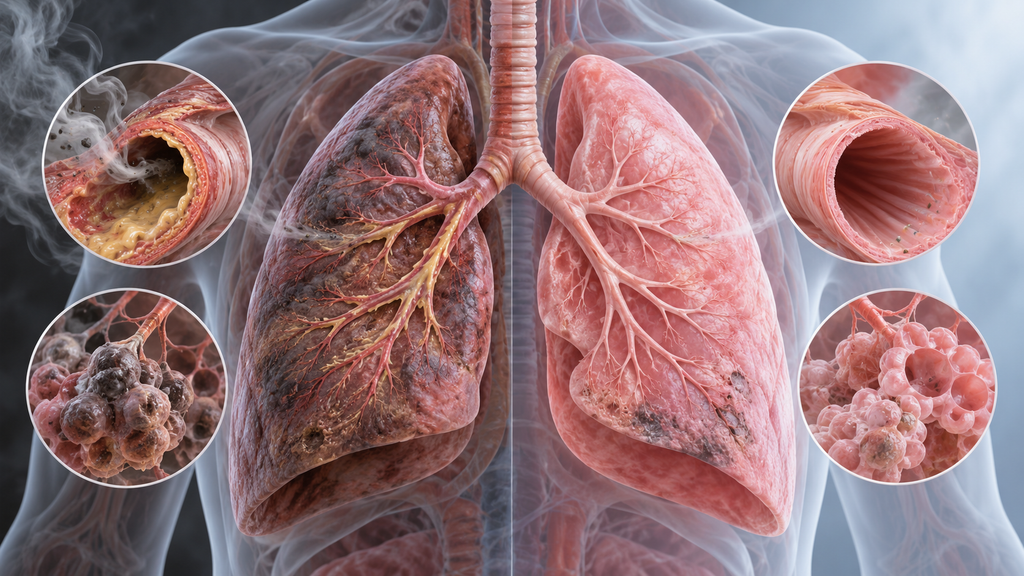
Destroyed alveolar walls in established emphysema do not simply regenerate back to their original architecture. Advanced structural changes and scarring may therefore persist even after smoking cessation. That does not mean quitting is pointless once damage has occurred.
Stopping continued smoke exposure can reduce further injury and lower the risk of numerous smoking-related diseases.
Does Lung Cancer Risk Fall After Quitting?
Yes — but not immediately to the level of someone who has never smoked.
The risk declines progressively after smoking cessation.
CDC reports that approximately 10–15 years after quitting, the added risk of lung cancer falls by about half compared with continued smoking. The exact risk for an individual depends on factors such as age, duration and intensity of previous smoking, and other exposures.
This illustrates an important principle:
The earlier someone stops smoking, the more future exposure is avoided — but quitting remains beneficial even after many years of smoking.
Can Your Lungs Completely Heal After Smoking?
There is no single answer because smoking affects multiple lung structures differently.
Some changes can improve substantially.
Airway irritation can decrease. Respiratory symptoms may improve. Lung-function decline can slow. The risk of respiratory disease and lung cancer decreases over time compared with continued smoking.
Other changes, particularly advanced emphysematous destruction, may be permanent.
So rather than asking whether the lungs can become exactly “like new,” a better question is:
Can stopping smoking reduce further damage and improve future health?
The answer is clearly yes.
When Should You Seek Medical Advice?
People who smoke or previously smoked should not automatically assume that persistent respiratory symptoms are simply a normal consequence of smoking.
Medical evaluation may be appropriate for symptoms such as:
- persistent or changing cough
- unexplained shortness of breath
- wheezing
- recurrent respiratory infections
- coughing up blood
- unexplained weight loss
- persistent chest discomfort
- a noticeable decline in exercise tolerance
Some people with a significant smoking history may also qualify for lung cancer screening with low-dose CT, depending on their age and cumulative smoking exposure. Eligibility varies by country and guideline, so this should be discussed with a healthcare professional.
The Bottom Line
Smoking damages the lungs through multiple interconnected mechanisms.
Cigarette smoke injures respiratory defenses, disrupts mucus clearance, promotes chronic inflammation, damages small airways, and can progressively destroy the alveolar structures responsible for efficient gas exchange.
At the cellular level, carcinogens in tobacco smoke can damage DNA and substantially increase the risk of lung cancer.
With prolonged exposure, these effects can contribute to chronic bronchitis, emphysema, COPD, respiratory infections, declining lung function, and cancer.
Some smoking-related changes improve after quitting, while advanced structural damage may not be completely reversible.
But stopping smoking remains one of the most important actions a person who smokes can take to protect their lungs and overall health — regardless of age or how long they have smoked.
Frequently Asked Questions
How quickly does smoking damage your lungs?
Some effects, such as airway irritation and changes in respiratory defenses, can begin with smoke exposure. Clinically significant diseases such as COPD and lung cancer generally develop through cumulative damage over many years, although individual susceptibility varies considerably.
Can your lungs heal after you stop smoking?
Some changes can improve after quitting, including respiratory symptoms and the rate of lung-function decline. However, established structural destruction from emphysema may be irreversible.
Why do smokers cough so much?
Smoking increases airway irritation and mucus production while impairing normal mucus clearance. Coughing can therefore become an important mechanism for clearing accumulated mucus and inhaled material.
Does smoking destroy alveoli?
Long-term smoking can contribute to emphysema, in which walls between alveolar air spaces are destroyed. This reduces gas-exchange surface area and contributes to loss of normal lung elasticity.
Can smoking cause COPD?
Yes. Cigarette smoking is a major cause of COPD, although COPD can also occur in people who have never smoked
Does quitting smoking reduce lung cancer risk?
Yes. Lung cancer risk decreases after smoking cessation compared with continuing to smoke, although it does not immediately return to the risk of someone who has never smoked.
Medical Disclaimer
This article is for educational purposes only and is not a substitute for professional medical advice, diagnosis, or treatment. Persistent or concerning respiratory symptoms should be evaluated by a qualified healthcare professional.
Medical Sources & Further Reading
- Centers for Disease Control and Prevention (CDC). Health Effects of Cigarettes: Chronic Obstructive Pulmonary Disease (COPD).
- Centers for Disease Control and Prevention (CDC). Lung Cancer Risk Factors.
- Centers for Disease Control and Prevention (CDC). Respiratory Care Settings and Smoking Cessation.
- U.S. Department of Health and Human Services, Office of the Surgeon General. Smoking Cessation: A Report of the Surgeon General. 2020.